Ch. 9 - Substitution and Elimination Reactions of Alkyl Halides
Bruice - Organic Chemistry 8th Edition
Bruice8th EditionOrganic ChemistryISBN: 9780135213711Not the one you use?Change textbook
Chapter 10, Problem 99f

What are the products of the following reactions?
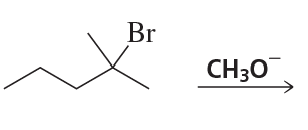
f. Diagram illustrating an organic reaction with a bromine atom and methanol as a nucleophile, showing product formation.

Verified step by step guidance
1
Analyze the structure of the reactant: The given molecule is a tertiary alkyl bromide, as the carbon attached to the bromine atom is bonded to three other carbon atoms.
Identify the reagent: The reagent is methoxide ion (CH₃O⁻), which is a strong base and a good nucleophile. This suggests that the reaction could proceed via an elimination (E2) or substitution (SN2) mechanism.
Determine the reaction mechanism: Since the substrate is a tertiary alkyl halide, steric hindrance makes SN2 unlikely. The strong base (CH₃O⁻) favors the E2 elimination mechanism.
Predict the elimination product: In an E2 reaction, the base abstracts a β-hydrogen (a hydrogen atom on a carbon adjacent to the carbon bearing the leaving group). The bromine atom leaves as Br⁻, and a double bond forms between the α-carbon (the carbon attached to the bromine) and the β-carbon. Consider all possible β-hydrogens to determine the major product based on Zaitsev's rule, which states that the more substituted alkene is usually the major product.
Draw the product(s): The major product will be the more substituted alkene, while the minor product (if any) will be the less substituted alkene. Ensure to account for stereochemistry if applicable.

Verified video answer for a similar problem:

This video solution was recommended by our tutors as helpful for the problem above.
Video duration:
4m
Was this helpful?

Key Concepts

Here are the essential concepts you must grasp in order to answer the question correctly.

Elimination Reactions

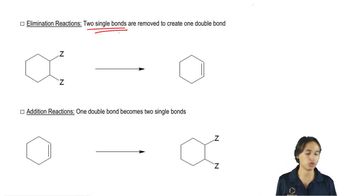
Elimination reactions involve the removal of a small molecule from a larger one, typically resulting in the formation of a double bond. In this case, the reaction involves the elimination of a bromide ion (Br-) and a proton (H+) from the substrate, leading to the formation of an alkene. Understanding the mechanism of elimination is crucial for predicting the products of such reactions.
Recommended video:
Guided course
00:40
Recognizing Elimination Reactions.

Nucleophiles

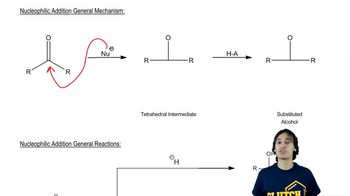
Nucleophiles are species that donate an electron pair to form a chemical bond in a reaction. In this scenario, methoxide (CH3O-) acts as a nucleophile, attacking the carbon atom bonded to the bromine. Recognizing the role of nucleophiles helps in understanding how they influence the outcome of elimination reactions and the stability of the resulting products.
Recommended video:
Guided course
08:27
Nucleophilic Addition

Zaitsev's Rule

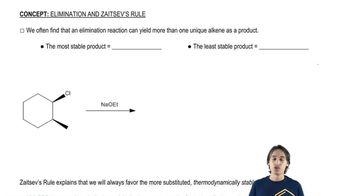
Zaitsev's Rule states that in elimination reactions, the more substituted alkene is typically the major product. This principle is important for predicting the outcome of the reaction shown, as the formation of the more stable, substituted alkene will be favored over less substituted alternatives. Applying this rule allows chemists to anticipate the preferred product in elimination scenarios.
Recommended video:
Guided course
01:18
Defining Zaitsev’s Rule