Ch. 9 - Substitution and Elimination Reactions of Alkyl Halides
Bruice - Organic Chemistry 8th Edition
Bruice8th EditionOrganic ChemistryISBN: 9780135213711Not the one you use?Change textbook
Chapter 10, Problem 131

The reaction of chloromethane with hydroxide ion at 30 °C has a ΔG° value of −21.7 kcal/mol. What is the equilibrium constant for the reaction?

Verified step by step guidance
1
Understand the relationship between the Gibbs free energy change (ΔG°) and the equilibrium constant (K) using the equation: ΔG°=-RTlnK, where R is the gas constant (1.987 cal/(mol·K)), T is the temperature in Kelvin, and K is the equilibrium constant.
Convert the given temperature from Celsius to Kelvin using the formula: T=t+273.15. For 30°C, calculate T in Kelvin.
Rearrange the equation to solve for the equilibrium constant (K): K=e^(-ΔG/(RT)). Substitute the values for ΔG° (−21.7 kcal/mol, converted to cal/mol), R (1.987 cal/(mol·K)), and T (calculated in the previous step).
Perform the calculation inside the exponent: divide the value of -ΔG by the product of R and T.
Finally, calculate the exponential term to determine the value of K. This will give you the equilibrium constant for the reaction.

Verified video answer for a similar problem:

This video solution was recommended by our tutors as helpful for the problem above.
Video duration:
3m
Was this helpful?

Key Concepts

Here are the essential concepts you must grasp in order to answer the question correctly.

Gibbs Free Energy (ΔG°)

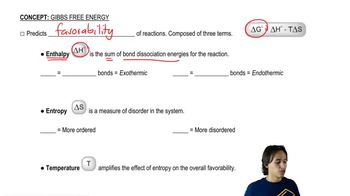
Gibbs Free Energy (ΔG°) is a thermodynamic potential that measures the maximum reversible work obtainable from a thermodynamic system at constant temperature and pressure. A negative ΔG° value indicates that a reaction is spontaneous under standard conditions, meaning it can proceed without external energy input. In this case, the ΔG° of -21.7 kcal/mol suggests that the reaction of chloromethane with hydroxide ion is favorable.
Recommended video:
Guided course
05:02
Breaking down the different terms of the Gibbs Free Energy equation.

Equilibrium Constant (K)

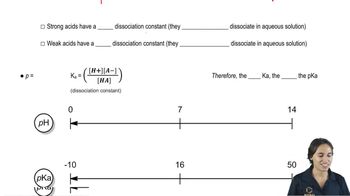
The equilibrium constant (K) is a dimensionless number that expresses the ratio of the concentrations of products to reactants at equilibrium for a given reaction at a specific temperature. It is derived from the Gibbs Free Energy change, where a negative ΔG° corresponds to a K value greater than 1, indicating that products are favored at equilibrium. The relationship between ΔG° and K is given by the equation ΔG° = -RT ln(K), where R is the gas constant and T is the temperature in Kelvin.
Recommended video:
Guided course
02:19
The relationship between equilibrium constant and pKa.

Temperature and Reaction Dynamics

Temperature plays a crucial role in chemical reactions, influencing both the rate and the position of equilibrium. In this context, the reaction occurs at 30°C, which must be converted to Kelvin for calculations. The temperature affects the kinetic energy of molecules, thereby impacting the likelihood of successful collisions between reactants. Understanding how temperature interacts with Gibbs Free Energy and the equilibrium constant is essential for predicting reaction behavior.
Recommended video:
3:22
EAS Reactions of Pyridine Concept 3