
Ch. 9 - Substitution and Elimination Reactions of Alkyl Halides
Bruice - Organic Chemistry 8th Edition
Bruice8th EditionOrganic ChemistryISBN: 9780135213711Not the one you use?Change textbook
Chapter 10, Problem 2

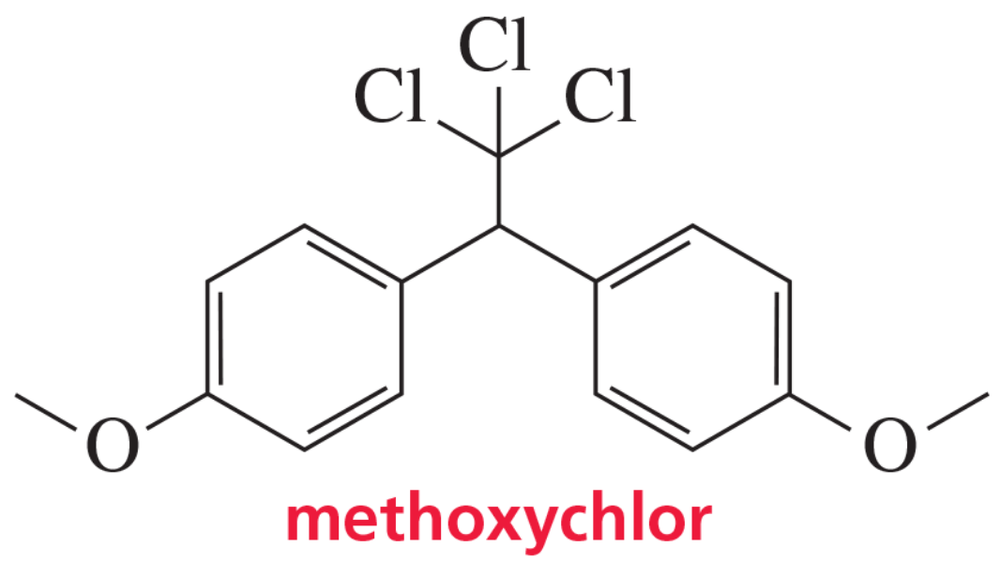
Methoxychlor is an insecticide that was intended to take DDT’s place because it is not as soluble in fatty tissues and is more readily biodegradable. It, too, can accumulate in the environment, however, so its use was also banned—in 2002 in the European Union and in 2003 in the United States. Why is methoxychlor less soluble in fatty tissues than DDT?

Verified step by step guidance
1
Analyze the structure of methoxychlor: It contains two aromatic rings, each substituted with a methoxy group (-OCH3), and a central carbon bonded to three chlorine atoms.
Compare methoxychlor to DDT: DDT has two aromatic rings without methoxy groups and a central carbon bonded to three chlorine atoms. The absence of polar functional groups in DDT makes it highly hydrophobic and more soluble in fatty tissues.
Understand the role of methoxy groups: The methoxy groups (-OCH3) in methoxychlor introduce polarity to the molecule due to the electronegativity of oxygen. This increases its ability to interact with polar solvents like water and decreases its hydrophobicity.
Explain solubility in fatty tissues: Fatty tissues are nonpolar environments, favoring the solubility of nonpolar molecules like DDT. Methoxychlor, being more polar due to the methoxy groups, is less compatible with nonpolar fatty tissues.
Conclude why methoxychlor is less soluble: The increased polarity from the methoxy groups reduces methoxychlor's solubility in fatty tissues compared to DDT, which lacks these polar functional groups.

Verified video answer for a similar problem:

This video solution was recommended by our tutors as helpful for the problem above.
Video duration:
5m
Was this helpful?

Key Concepts

Here are the essential concepts you must grasp in order to answer the question correctly.

Hydrophobicity and Lipophilicity

Hydrophobicity refers to the tendency of a compound to repel water, while lipophilicity indicates its affinity for fats and oils. Compounds that are more lipophilic tend to accumulate in fatty tissues. Methoxychlor's lower lipophilicity compared to DDT means it is less likely to dissolve in fatty tissues, leading to reduced bioaccumulation.
Recommended video:
2:00
Fatty Acids Concept 1

Chemical Structure and Functional Groups

The chemical structure of a compound, including its functional groups, significantly influences its solubility properties. Methoxychlor has a different arrangement of functional groups compared to DDT, which affects its interaction with lipid membranes and its overall solubility in fatty tissues.
Recommended video:
Guided course
02:36
Identifying Functional Groups

Biodegradability

Biodegradability refers to the ability of a substance to be broken down by biological organisms, such as bacteria. Methoxychlor is designed to be more readily biodegradable than DDT, which contributes to its lower environmental persistence and accumulation in living organisms, making it a more favorable alternative despite its eventual ban.
Recommended video:
Guided course
03:28
The mechanism of Radical Polymerization.