Ch. 9 - Substitution and Elimination Reactions of Alkyl Halides
Bruice - Organic Chemistry 8th Edition
Bruice8th EditionOrganic ChemistryISBN: 9780135213711Not the one you use?Change textbook
Chapter 10, Problem 93a

Indicate which species in each pair gives a higher substitution-product-to-elimination-product ratio when it reacts with isopropyl bromide:
a. ethoxide ion or tert-butoxide ion

Verified step by step guidance
1
Understand the problem: The question asks us to compare the substitution-product-to-elimination-product ratio for two bases (ethoxide ion and tert-butoxide ion) when reacting with isopropyl bromide. This involves understanding the competition between substitution (SN2 or SN1) and elimination (E2 or E1) reactions.
Analyze the structure of the bases: Ethoxide ion (CH₃CH₂O⁻) is a smaller, less sterically hindered base, while tert-butoxide ion ((CH₃)₃CO⁻) is a bulky, sterically hindered base. Bulky bases tend to favor elimination (E2) over substitution because they have difficulty approaching the electrophilic carbon for substitution.
Consider the substrate: Isopropyl bromide ((CH₃)₂CHBr) is a secondary alkyl halide. Secondary alkyl halides can undergo both substitution and elimination, but the pathway depends on the nature of the base/nucleophile and reaction conditions.
Relate the base to the reaction pathway: Ethoxide ion, being smaller and less hindered, is more likely to act as a nucleophile and favor substitution (SN2) over elimination. In contrast, tert-butoxide ion, due to its bulkiness, is more likely to favor elimination (E2) over substitution.
Conclude the comparison: Since ethoxide ion is less hindered and more nucleophilic, it will give a higher substitution-product-to-elimination-product ratio compared to tert-butoxide ion when reacting with isopropyl bromide.

Verified video answer for a similar problem:

This video solution was recommended by our tutors as helpful for the problem above.
Video duration:
1m
Was this helpful?

Key Concepts

Here are the essential concepts you must grasp in order to answer the question correctly.

Nucleophilicity

Nucleophilicity refers to the ability of a species to donate an electron pair to form a chemical bond. In the context of substitution reactions, stronger nucleophiles tend to favor the formation of substitution products over elimination products. Ethoxide ion, being a smaller and less sterically hindered nucleophile compared to tert-butoxide ion, is more effective in attacking the electrophile, leading to a higher substitution-product-to-elimination-product ratio.
Recommended video:
Guided course
08:27
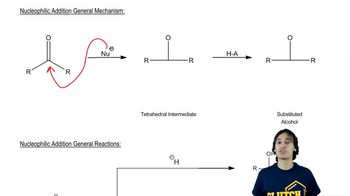
Nucleophilic Addition

Steric Hindrance

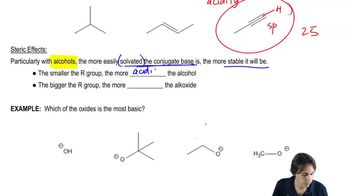
Steric hindrance is the prevention of reactions at a particular location within a molecule due to the size of substituent groups. Tert-butoxide ion is bulkier than ethoxide ion, which can hinder its ability to approach and react with the electrophile, isopropyl bromide. This increased steric hindrance in tert-butoxide ion leads to a preference for elimination reactions over substitution, resulting in a lower substitution-product-to-elimination-product ratio.
Recommended video:
Guided course
02:53
Understanding steric effects.

Substitution vs. Elimination Reactions

Substitution and elimination reactions are two fundamental types of reactions that can occur when a nucleophile reacts with an alkyl halide. In substitution reactions, the nucleophile replaces the leaving group, while in elimination reactions, the nucleophile abstracts a proton, resulting in the formation of a double bond. The choice of nucleophile and the reaction conditions can influence the ratio of substitution to elimination products, with more nucleophilic and less sterically hindered species favoring substitution.
Recommended video:
Guided course
00:38
Intro to Substitution/Elimination Problems