Ch. 9 - Substitution and Elimination Reactions of Alkyl Halides
Bruice - Organic Chemistry 8th Edition
Bruice8th EditionOrganic ChemistryISBN: 9780135213711Not the one you use?Change textbook
Chapter 10, Problem 62

Identify the three products formed when 2-bromo-2-methylpropane is dissolved in a mixture of 80% ethanol and 20% water.

Verified step by step guidance
1
Analyze the structure of 2-bromo-2-methylpropane. It is a tertiary alkyl halide, meaning the carbon attached to the bromine is bonded to three other carbon atoms. This makes it prone to undergoing substitution and elimination reactions via the SN1 and E1 mechanisms.
Recognize the solvent system: 80% ethanol and 20% water. This is a polar protic solvent, which stabilizes carbocations and favors the SN1 and E1 mechanisms. The solvent can also act as a nucleophile (ethanol and water) or a base (ethanol).
Understand the SN1 mechanism: The first step is the formation of a carbocation by the loss of the bromide ion (Br⁻). The carbocation can then react with the nucleophiles present in the solvent (ethanol and water) to form substitution products. Ethanol will form an ethoxy product, and water will form an alcohol product after proton transfer.
Understand the E1 mechanism: The carbocation can also lose a proton (H⁺) from a β-hydrogen atom, leading to the formation of an alkene product. Ethanol, acting as a weak base, facilitates this elimination reaction.
Combine the results: The three products formed are (1) the ethoxy substitution product (from ethanol), (2) the alcohol substitution product (from water), and (3) the alkene elimination product (via E1).

Verified video answer for a similar problem:

This video solution was recommended by our tutors as helpful for the problem above.
Video duration:
7m
Was this helpful?

Key Concepts

Here are the essential concepts you must grasp in order to answer the question correctly.

Nucleophilic Substitution

Nucleophilic substitution is a fundamental reaction in organic chemistry where a nucleophile replaces a leaving group in a molecule. In the case of 2-bromo-2-methylpropane, the bromine atom acts as the leaving group, and the nucleophile can be either ethanol or water, leading to different substitution products.
Recommended video:
Guided course
01:47
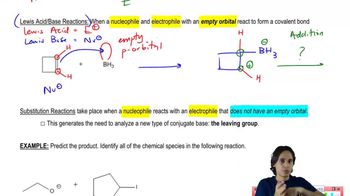
Nucleophiles and Electrophiles can react in Substitution Reactions.

Ethanol as a Solvent

Ethanol, being a polar protic solvent, can stabilize ions and facilitate nucleophilic attacks. In a mixture of 80% ethanol and 20% water, ethanol can act as a nucleophile, leading to the formation of ethyl 2-methylpropyl ether, while water can lead to the formation of 2-methylpropan-2-ol through substitution.
Recommended video:
Guided course
00:20
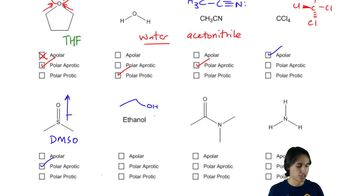
Identification of polarity in solvents

Elimination Reactions

Elimination reactions involve the removal of a small molecule from a larger one, often resulting in the formation of alkenes. In the presence of a strong base or under certain conditions, 2-bromo-2-methylpropane can undergo elimination to form alkenes, such as 2-methylpropene, alongside the substitution products.
Recommended video:
Guided course
00:40
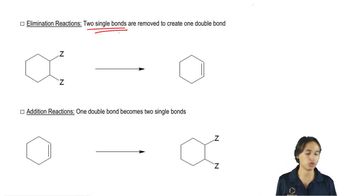
Recognizing Elimination Reactions.