Ch. 9 - Substitution and Elimination Reactions of Alkyl Halides
Bruice - Organic Chemistry 8th Edition
Bruice8th EditionOrganic ChemistryISBN: 9780135213711Not the one you use?Change textbook
Chapter 10, Problem 96a

For each of the following alkyl halides, indicate the stereoisomer that would be obtained in greatest yield in an E2 reaction.
a. 3-bromo-2,2,3-trimethylpentane

Verified step by step guidance
1
Identify the type of elimination reaction: The E2 reaction is a bimolecular elimination reaction that requires a strong base and occurs in a single concerted step. It typically follows anti-periplanar geometry, where the β-hydrogen and the leaving group (halide) must be in opposite planes (anti-coplanar).
Analyze the structure of the alkyl halide: The given compound is 3-bromo-2,2,3-trimethylpentane. The bromine atom is attached to the third carbon, and the molecule has bulky substituents on the second and third carbons. This steric hindrance will influence the reaction pathway.
Locate the β-hydrogens: Identify the β-carbons (carbons adjacent to the carbon bearing the bromine atom). In this case, the β-carbons are C2 and C4. Check for the presence of β-hydrogens on these carbons. Note that C2 has no β-hydrogens due to the presence of three methyl groups, while C4 has β-hydrogens available for elimination.
Determine the anti-periplanar geometry: For the E2 reaction to proceed, the β-hydrogen on C4 and the bromine on C3 must adopt an anti-periplanar conformation. Draw the Newman projection along the C3-C4 bond to confirm this geometry. Rotate the molecule if necessary to achieve the required alignment.
Predict the major product: The elimination will result in the formation of a double bond between C3 and C4. Since the E2 reaction favors the formation of the more substituted (and thus more stable) alkene, the major product will be the stereoisomer with the double bond in the (E)-configuration, assuming it is sterically and electronically favored.

Verified video answer for a similar problem:

This video solution was recommended by our tutors as helpful for the problem above.
Video duration:
5m
Was this helpful?

Key Concepts

Here are the essential concepts you must grasp in order to answer the question correctly.

E2 Reaction Mechanism

The E2 (bimolecular elimination) reaction is a concerted process where a base abstracts a proton while a leaving group departs, resulting in the formation of a double bond. This mechanism typically requires a strong base and occurs in a single step, leading to the formation of alkenes. The stereochemistry of the substrate plays a crucial role, as the reaction favors anti-periplanar geometry for optimal overlap of orbitals.
Recommended video:
Guided course
09:36
Drawing the E2 Mechanism.

Stereochemistry and Stereoisomers

Stereochemistry refers to the spatial arrangement of atoms in molecules and how this affects their chemical properties. Stereoisomers are compounds that have the same molecular formula and connectivity but differ in the orientation of their atoms in space. In E2 reactions, the stereochemistry of the alkyl halide influences which stereoisomer is formed preferentially, often favoring the more stable trans or E isomer.
Recommended video:
1:38
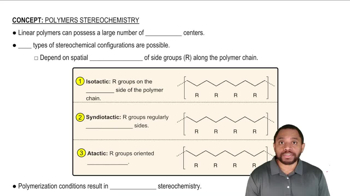
Polymer Stereochemistry Concept 1

Substituent Effects on Elimination Reactions

The structure of the alkyl halide, including the presence of bulky substituents, significantly impacts the outcome of E2 reactions. Bulky groups can hinder the approach of the base, affecting the reaction's rate and the stereochemical outcome. In the case of 3-bromo-2,2,3-trimethylpentane, the steric hindrance from the methyl groups will influence which hydrogen is abstracted, leading to the formation of the most stable alkene product.
Recommended video:
Guided course
00:38
Intro to Substitution/Elimination Problems