Ch. 9 - Substitution and Elimination Reactions of Alkyl Halides
Bruice - Organic Chemistry 8th Edition
Bruice8th EditionOrganic ChemistryISBN: 9780135213711Not the one you use?Change textbook
Chapter 10, Problem 8

Draw the substitution product formed by each of the following SN2 reactions:
a. trans-1-iodo-4-ethylcyclohexane and methoxide ion
b. cis-1-chloro-3-methylcyclobutane and ethoxide ion

Verified step by step guidance
1
Step 1: Understand the SN2 reaction mechanism. SN2 (bimolecular nucleophilic substitution) reactions occur in a single step where the nucleophile attacks the electrophilic carbon (bearing the leaving group) from the opposite side, leading to inversion of configuration at the carbon center. This is known as a 'backside attack.'
Step 2: For part (a), identify the substrate and nucleophile. The substrate is trans-1-iodo-4-ethylcyclohexane, and the nucleophile is the methoxide ion (CH₃O⁻). The iodine atom is the leaving group. The methoxide ion will attack the carbon bonded to iodine from the opposite side, displacing iodine and inverting the configuration at that carbon. Draw the product with the methoxy group replacing iodine, ensuring the stereochemistry is inverted.
Step 3: For part (b), identify the substrate and nucleophile. The substrate is cis-1-chloro-3-methylcyclobutane, and the nucleophile is the ethoxide ion (CH₃CH₂O⁻). The chlorine atom is the leaving group. The ethoxide ion will attack the carbon bonded to chlorine from the opposite side, displacing chlorine and inverting the configuration at that carbon. Draw the product with the ethoxy group replacing chlorine, ensuring the stereochemistry is inverted.
Step 4: Pay attention to the stereochemistry of the products. In SN2 reactions, the stereochemistry of the carbon undergoing substitution is inverted. For part (a), the product will have the methoxy group in the opposite stereochemical position relative to the original iodine. For part (b), the product will have the ethoxy group in the opposite stereochemical position relative to the original chlorine.
Step 5: Verify the final structures. Ensure that the leaving groups (iodine in part (a) and chlorine in part (b)) are completely removed, the nucleophiles (methoxide and ethoxide) are correctly attached, and the stereochemistry of the substituted carbons is inverted. This will give you the correct substitution products for both reactions.

Verified video answer for a similar problem:

This video solution was recommended by our tutors as helpful for the problem above.
Video duration:
4m
Was this helpful?

Key Concepts

Here are the essential concepts you must grasp in order to answer the question correctly.

SN2 Mechanism

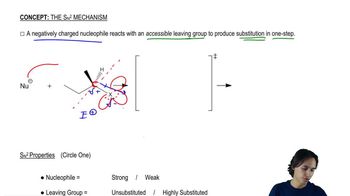
The SN2 mechanism is a type of nucleophilic substitution reaction where a nucleophile attacks an electrophile, resulting in the simultaneous displacement of a leaving group. This bimolecular process involves a single transition state and is characterized by a backside attack, leading to inversion of configuration at the carbon center. Understanding this mechanism is crucial for predicting the stereochemical outcome of the reactions.
Recommended video:
Guided course
08:33
Drawing the SN2 Mechanism

Stereochemistry

Stereochemistry refers to the spatial arrangement of atoms in molecules and how this affects their chemical behavior. In the context of SN2 reactions, the stereochemistry of the starting material influences the configuration of the product. For example, if the starting material is chiral, the inversion of configuration during the reaction will yield a product with the opposite stereochemistry.
Recommended video:
1:38
Polymer Stereochemistry Concept 1

Nucleophiles and Leaving Groups

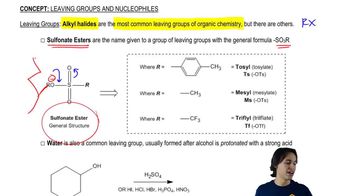
Nucleophiles are species that donate an electron pair to form a chemical bond, while leaving groups are atoms or groups that can depart with a pair of electrons during a reaction. The strength of the nucleophile and the quality of the leaving group significantly influence the rate and outcome of SN2 reactions. Strong nucleophiles and good leaving groups facilitate faster and more efficient substitution processes.
Recommended video:
Guided course
07:22
The 3 important leaving groups to know.