Ch. 9 - Substitution and Elimination Reactions of Alkyl Halides
Bruice - Organic Chemistry 8th Edition
Bruice8th EditionOrganic ChemistryISBN: 9780135213711Not the one you use?Change textbook
Chapter 10, Problem 18a,b

Draw the stereoisomers that are formed from the following SN1 reactions:
a. 3-bromo-3-methylpentane and methanol
b. 3-chloro-3-methylhexane and methanol

Verified step by step guidance
1
Step 1: Understand the SN1 reaction mechanism. SN1 reactions proceed via a two-step mechanism: (1) the leaving group departs, forming a carbocation intermediate, and (2) the nucleophile attacks the carbocation. The carbocation intermediate is planar, allowing for the formation of stereoisomers.
Step 2: Analyze the substrate in part (a), 3-bromo-3-methylpentane. When the bromine atom leaves, a tertiary carbocation is formed at the 3rd carbon. Tertiary carbocations are stable due to hyperconjugation and inductive effects.
Step 3: Consider the nucleophile, methanol (CH₃OH). Methanol can attack the planar carbocation from either side, leading to the formation of two stereoisomers: one with the nucleophile on the front side and one on the back side. These stereoisomers are enantiomers.
Step 4: Repeat the analysis for part (b), 3-chloro-3-methylhexane. When the chlorine atom leaves, a tertiary carbocation is formed at the 3rd carbon. Similar to part (a), the planar carbocation allows methanol to attack from either side, forming two stereoisomers.
Step 5: Draw the stereoisomers for both reactions. For each reaction, depict the two enantiomers formed by the attack of methanol on the planar carbocation. Ensure that the stereochemistry is clearly indicated in the drawings, showing the nucleophile on opposite sides of the plane.

Verified video answer for a similar problem:

This video solution was recommended by our tutors as helpful for the problem above.
Video duration:
6m
Was this helpful?

Key Concepts

Here are the essential concepts you must grasp in order to answer the question correctly.

Stereoisomerism

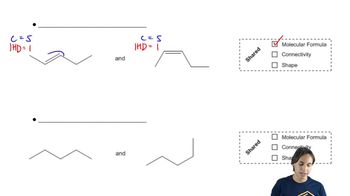
Stereoisomerism refers to the phenomenon where compounds have the same molecular formula and connectivity of atoms but differ in the spatial arrangement of their atoms. This can lead to different physical and chemical properties. In organic chemistry, stereoisomers include enantiomers and diastereomers, which are crucial for understanding the outcomes of reactions like SN1.
Recommended video:
Guided course
01:58
Determining when molecules are stereoisomers.

SN1 Reaction Mechanism

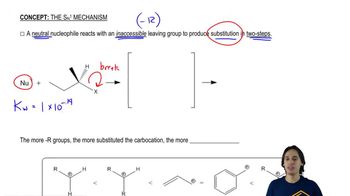
The SN1 (nucleophilic substitution unimolecular) reaction mechanism involves two main steps: the formation of a carbocation intermediate and the subsequent nucleophilic attack. The rate-determining step is the formation of the carbocation, which is influenced by the stability of the carbocation and the solvent used. This mechanism often leads to racemization due to the planar nature of the carbocation.
Recommended video:
Guided course
10:49
Drawing the SN1 Mechanism

Carbocation Stability

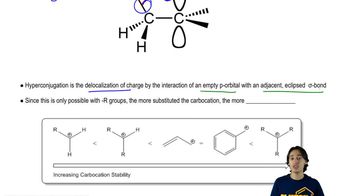
Carbocation stability is a key factor in determining the outcome of SN1 reactions. Carbocations are positively charged species that can be classified based on their degree of substitution: tertiary (most stable), secondary, and primary (least stable). The stability of the carbocation affects the rate of the reaction and the types of stereoisomers formed, as more stable carbocations are more likely to form and react.
Recommended video:
Guided course
05:58
Determining Carbocation Stability