Ch. 9 - Substitution and Elimination Reactions of Alkyl Halides
Bruice - Organic Chemistry 8th Edition
Bruice8th EditionOrganic ChemistryISBN: 9780135213711Not the one you use?Change textbook
Chapter 10, Problem 83e

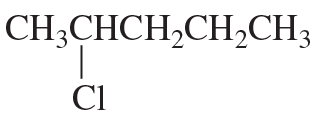
Draw the major product obtained when each of the following alkyl halides undergoes an E2 reaction:
e. Structural formula of an alkyl halide with a chlorine atom attached, indicating an E2 reaction mechanism.

Verified step by step guidance
1
Identify the alkyl halide structure and classify it as primary, secondary, or tertiary. This classification will help determine the reactivity and the likelihood of elimination (E2) over substitution (SN2).
Recall the E2 mechanism: it is a one-step, concerted reaction where a strong base abstracts a β-hydrogen (hydrogen on a carbon adjacent to the carbon bearing the leaving group), and the leaving group departs simultaneously, forming a double bond.
Locate all β-hydrogens in the molecule. Identify the β-carbon(s) adjacent to the carbon bonded to the leaving group. These β-hydrogens are potential candidates for elimination.
Determine the most substituted alkene product (Zaitsev's rule) as the major product. The base will preferentially abstract a β-hydrogen that leads to the formation of the more stable, highly substituted alkene. However, if a bulky base is used, the less substituted alkene (Hofmann product) may dominate.
Draw the structure of the major alkene product, ensuring proper placement of the double bond between the α-carbon (carbon bearing the leaving group) and the β-carbon from which the hydrogen was removed.

Verified video answer for a similar problem:

This video solution was recommended by our tutors as helpful for the problem above.
Video duration:
2m
Was this helpful?

Key Concepts

Here are the essential concepts you must grasp in order to answer the question correctly.

E2 Reaction Mechanism

The E2 (bimolecular elimination) reaction is a type of elimination reaction where a base removes a proton from a β-carbon while a leaving group departs from the α-carbon simultaneously. This concerted mechanism results in the formation of a double bond between the α and β carbons. Understanding the stereochemistry and the requirement for anti-periplanar geometry is crucial for predicting the major product.
Recommended video:
Guided course
09:36
Drawing the E2 Mechanism.

Alkyl Halides

Alkyl halides are organic compounds containing a carbon atom bonded to a halogen atom (F, Cl, Br, I). They serve as substrates in various reactions, including E2 eliminations. The structure of the alkyl halide, such as whether it is primary, secondary, or tertiary, significantly influences the reaction pathway and the stability of the resulting alkene.
Recommended video:
Guided course
01:52
How to name alkyl halides

Base Strength and Sterics

The strength and steric properties of the base used in an E2 reaction are critical for determining the reaction's outcome. Strong bases, such as alkoxides or hydrides, favor E2 mechanisms, while bulky bases can lead to different regioselectivity. Additionally, the steric hindrance around the alkyl halide can affect the accessibility of the β-hydrogen, influencing the formation of the major product.
Recommended video:
Guided course
02:53
Understanding steric effects.