Ch. 9 - Substitution and Elimination Reactions of Alkyl Halides
Bruice - Organic Chemistry 8th Edition
Bruice8th EditionOrganic ChemistryISBN: 9780135213711Not the one you use?Change textbook
Chapter 10, Problem 11

a. Which is a stronger base: RO or RS?
b. Which is a better nucleophile in an aqueous solution?
c. Which is a better nucleophile in DMSO?

Verified step by step guidance
1
Step 1: To determine which is a stronger base (RO⁻ or RS⁻), consider the periodic trends in electronegativity and the stability of the conjugate acid. Oxygen (O) is more electronegative than sulfur (S), meaning RO⁻ holds onto its negative charge more tightly, making it less stable and a stronger base. RS⁻, on the other hand, is more stable due to the larger size of sulfur, which can better delocalize the negative charge.
Step 2: To determine which is a better nucleophile in an aqueous solution, consider the solvation effects. In water, the smaller RO⁻ ion is more strongly solvated due to hydrogen bonding, which reduces its nucleophilicity. RS⁻, being larger and less solvated, is a better nucleophile in aqueous solution.
Step 3: To determine which is a better nucleophile in DMSO (a polar aprotic solvent), consider the lack of hydrogen bonding in such solvents. In DMSO, solvation effects are minimal, so the intrinsic nucleophilicity of the species dominates. RS⁻, being larger and more polarizable, is a better nucleophile than RO⁻ in DMSO.
Step 4: Summarize the periodic trends and solvent effects. The strength of a base is influenced by electronegativity and charge delocalization, while nucleophilicity depends on solvation and polarizability. RO⁻ is a stronger base, but RS⁻ is a better nucleophile in both aqueous and DMSO solvents.
Step 5: Conclude by emphasizing the importance of understanding the interplay between periodic trends, solvent effects, and the specific properties of the nucleophile or base in question. This knowledge is crucial for predicting reactivity in organic chemistry.

Verified video answer for a similar problem:

This video solution was recommended by our tutors as helpful for the problem above.
Video duration:
4m
Was this helpful?

Key Concepts

Here are the essential concepts you must grasp in order to answer the question correctly.

Basicity

Basicity refers to the ability of a species to accept protons (H+). In organic chemistry, the strength of a base is often influenced by the stability of its conjugate acid. For alkoxide ions (RO−) and thiolate ions (RS−), the presence of electronegative atoms and resonance can affect their basicity, with RO− generally being a stronger base due to the higher electronegativity of oxygen compared to sulfur.
Recommended video:
Guided course
06:21
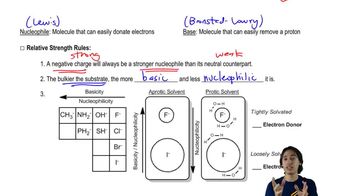
Understanding the difference between basicity and nucleophilicity.

Nucleophilicity

Nucleophilicity is the measure of a species' ability to donate an electron pair to an electrophile during a chemical reaction. Factors influencing nucleophilicity include charge, electronegativity, and solvent effects. In aqueous solutions, nucleophiles are often more hindered by solvation, while in polar aprotic solvents like DMSO, nucleophilicity can be enhanced due to reduced solvation of the nucleophile.
Recommended video:
Guided course
08:27
Nucleophilic Addition

Solvent Effects

Solvent effects play a crucial role in determining the reactivity of nucleophiles and bases. In polar protic solvents, such as water, nucleophiles are stabilized by hydrogen bonding, which can hinder their reactivity. Conversely, in polar aprotic solvents like DMSO, nucleophiles are less solvated, allowing for greater reactivity and making them better nucleophiles in such environments.
Recommended video:
Guided course
01:16
Identification of polarity in solvents