Ch. 8 - Delocalized Electrons: Their Effect on Stability, pKa, and the Products of a Reaction • Aromaticity and Electronic Effects: An Introduction to the Reactions of Benzene
Bruice - Organic Chemistry 8th Edition
Bruice8th EditionOrganic ChemistryISBN: 9780135213711Not the one you use?Change textbook
Chapter 9, Problem 40

What is the major product when the methoxy substituent in the preceding reaction is bonded to C-2 of the diene rather than to C-1?

Verified step by step guidance
1
Identify the diene structure and the substituent X in the given reaction. Understand the position of X-1 and X-2 on the diene, which are typically the first and second carbon atoms in the conjugated system.
Recognize that the reaction involves the addition of the substituent X to the diene. This is likely a type of electrophilic addition reaction, common in organic chemistry when dealing with dienes.
Consider the regioselectivity of the reaction. When the substituent X bonds to X-2 instead of X-1, it suggests a preference for the formation of a more stable intermediate, possibly due to resonance stabilization or steric factors.
Apply the concept of resonance to determine the stability of the intermediates formed. The bonding of X to X-2 may lead to a resonance-stabilized carbocation, which is often more favorable than bonding to X-1.
Predict the major product based on the stability of the intermediates. The major product will likely be the one formed from the more stable intermediate, which in this case is when X is bonded to X-2, leading to a more stable carbocation and thus a more stable final product.

Verified video answer for a similar problem:

This video solution was recommended by our tutors as helpful for the problem above.
Video duration:
6m
Was this helpful?

Key Concepts

Here are the essential concepts you must grasp in order to answer the question correctly.

Diels-Alder Reaction

The Diels-Alder reaction is a cycloaddition reaction between a conjugated diene and a dienophile, forming a six-membered ring. Understanding this reaction is crucial as it illustrates how substituents on the diene and dienophile influence the regioselectivity and stereochemistry of the product. The positioning of substituents can lead to different major products based on their reactivity and steric factors.
Recommended video:
Guided course
04:02
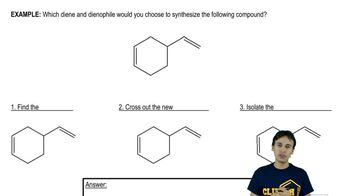
Diels-Alder Retrosynthesis

Regioselectivity

Regioselectivity refers to the preference of a chemical reaction to yield one structural isomer over others when multiple products are possible. In the context of the Diels-Alder reaction, the position where the substituent bonds to the diene significantly affects the major product formed. Recognizing how substituents influence the reaction pathway is essential for predicting the outcome of the reaction.
Recommended video:
Guided course
05:09
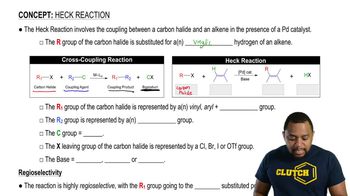
Heck Reaction

Substituent Effects

Substituent effects describe how different groups attached to a molecule can alter its reactivity and the stability of intermediates. In the Diels-Alder reaction, the nature of the substituents on the diene and dienophile can stabilize or destabilize certain transition states, thus influencing the major product. Understanding these effects helps in rationalizing why certain products are favored over others in a given reaction.
Recommended video:
2:02
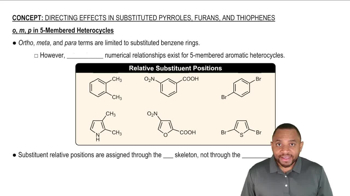
Directing Effects in Substituted Pyrroles, Furans, and Thiophenes Concept 1