Ch. 8 - Delocalized Electrons: Their Effect on Stability, pKa, and the Products of a Reaction • Aromaticity and Electronic Effects: An Introduction to the Reactions of Benzene
Bruice - Organic Chemistry 8th Edition
Bruice8th EditionOrganic ChemistryISBN: 9780135213711Not the one you use?Change textbook
Chapter 9, Problem 44b

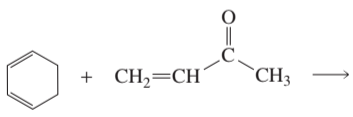
What are the products of the following reactions?
b. Chemical reaction diagram showing benzene and an alkene reacting to form a bridged product.

Verified step by step guidance
1
Identify the type of reaction taking place. For example, determine if it is a substitution, elimination, addition, or rearrangement reaction. This will depend on the reactants and reaction conditions provided in the problem.
Analyze the structure of the reactants. Look for functional groups, double or triple bonds, and any stereochemistry that might influence the reaction pathway.
Consider the reaction conditions (e.g., reagents, solvents, temperature, and catalysts). These will help you predict the mechanism and the products. For example, the use of a strong base might suggest an elimination reaction, while an acid catalyst might indicate an addition reaction.
Write out the mechanism step by step. Show how bonds are broken and formed, and use curved arrows to indicate the movement of electrons. This will help you visualize the intermediates and transition states.
Determine the final products by completing the reaction mechanism. Ensure that you account for all atoms and charges, and check for any stereochemical outcomes if applicable.

Verified video answer for a similar problem:

This video solution was recommended by our tutors as helpful for the problem above.
Video duration:
2m
Was this helpful?

Key Concepts

Here are the essential concepts you must grasp in order to answer the question correctly.

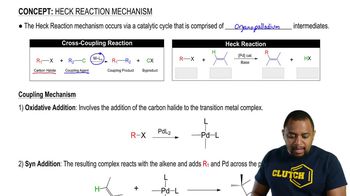
Reaction Mechanisms

Understanding reaction mechanisms is crucial in organic chemistry as they describe the step-by-step process by which reactants transform into products. This includes identifying intermediates, transition states, and the movement of electrons. A clear grasp of mechanisms helps predict the products of reactions and the conditions under which they occur.
Recommended video:
Guided course
02:16
Heck Reaction Mechanism

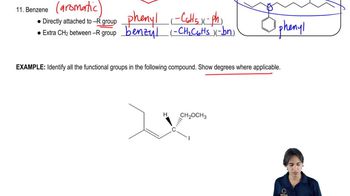
Functional Groups

Functional groups are specific groups of atoms within molecules that are responsible for the characteristic chemical reactions of those molecules. Recognizing functional groups is essential for predicting the behavior of organic compounds during reactions, as they dictate reactivity and the types of products formed.
Recommended video:
Guided course
02:36
Identifying Functional Groups

Stoichiometry

Stoichiometry involves the calculation of reactants and products in chemical reactions. It is essential for determining the amounts of substances consumed and produced, allowing chemists to predict yields and understand the proportions in which reactants react. Mastery of stoichiometry is vital for balancing chemical equations and optimizing reaction conditions.
Recommended video:
Guided course
02:08
Organic molecules in your everyday life.