Ch. 8 - Delocalized Electrons: Their Effect on Stability, pKa, and the Products of a Reaction • Aromaticity and Electronic Effects: An Introduction to the Reactions of Benzene
Bruice - Organic Chemistry 8th Edition
Bruice8th EditionOrganic ChemistryISBN: 9780135213711Not the one you use?Change textbook
Chapter 9, Problem 79

Rank the following carbocations from most stable to least stable:
Three carbocation structures are shown, illustrating varying stability levels for comparison.

Verified step by step guidance
1
Step 1: Analyze the stability of carbocations based on resonance. Resonance stabilization occurs when the positive charge on the carbocation can be delocalized over a conjugated π-system. Structures II and IV have conjugated double bonds adjacent to the carbocation, allowing for resonance stabilization.
Step 2: Consider hyperconjugation effects. Hyperconjugation occurs when alkyl groups adjacent to the carbocation donate electron density through σ-bond interactions. Structures I and III have alkyl groups that can provide hyperconjugation, but they lack resonance stabilization.
Step 3: Evaluate the position of the carbocation relative to the double bonds. In structure II, the carbocation is directly adjacent to two conjugated double bonds, providing the highest degree of resonance stabilization. Structure IV has one conjugated double bond adjacent to the carbocation, offering moderate resonance stabilization.
Step 4: Compare the remaining structures (I and III). Structure I has a carbocation adjacent to a single double bond, which provides limited resonance stabilization. Structure III has no resonance stabilization but benefits slightly from hyperconjugation due to the alkyl group.
Step 5: Rank the carbocations from most stable to least stable based on the above analysis: II > IV > I > III.

Verified video answer for a similar problem:

This video solution was recommended by our tutors as helpful for the problem above.
Video duration:
7m
Was this helpful?

Key Concepts

Here are the essential concepts you must grasp in order to answer the question correctly.

Carbocation Stability

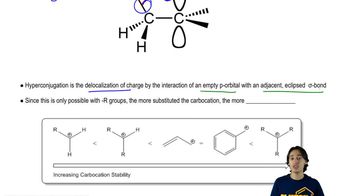
Carbocations are positively charged carbon species that can vary in stability based on their structure. Stability is influenced by factors such as the degree of substitution (primary, secondary, tertiary) and resonance. Tertiary carbocations are generally the most stable due to hyperconjugation and inductive effects from surrounding alkyl groups, while primary carbocations are the least stable.
Recommended video:
Guided course
05:58
Determining Carbocation Stability

Resonance

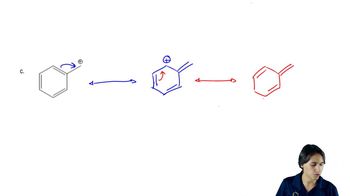
Resonance is a concept in organic chemistry where a molecule can be represented by two or more valid Lewis structures, known as resonance structures. These structures contribute to the overall stability of the molecule, as the actual structure is a hybrid of these forms. In carbocations, resonance can delocalize the positive charge, enhancing stability, particularly in structures with adjacent double bonds or lone pairs.
Recommended video:
Guided course
03:04
Drawing Resonance Structures

Inductive Effect

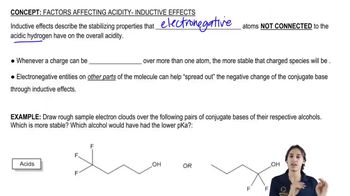
The inductive effect refers to the electron-withdrawing or electron-donating effects transmitted through sigma bonds in a molecule. Electronegative atoms or groups can stabilize a carbocation by pulling electron density away, while electron-donating groups can provide additional electron density to stabilize the positive charge. This effect plays a crucial role in determining the relative stability of different carbocations.
Recommended video:
Guided course
01:47
Understanding the Inductive Effect.