Ch. 8 - Delocalized Electrons: Their Effect on Stability, pKa, and the Products of a Reaction • Aromaticity and Electronic Effects: An Introduction to the Reactions of Benzene
Bruice - Organic Chemistry 8th Edition
Bruice8th EditionOrganic ChemistryISBN: 9780135213711Not the one you use?Change textbook
Chapter 9, Problem 111b

Draw the resonance contributors of the cyclooctatrienyl dianion.
b. Which of the resonance contributors makes the smallest contribution to the hybrid?

Verified step by step guidance
1
Step 1: Begin by understanding the structure of the cyclooctatrienyl dianion. Cyclooctatrienyl refers to an eight-membered ring with three alternating double bonds. The dianion indicates that the molecule has two extra electrons, which are typically delocalized within the conjugated system.
Step 2: Identify the resonance contributors. Resonance contributors are different Lewis structures that represent the delocalization of electrons in the molecule. For the cyclooctatrienyl dianion, the two extra electrons can be placed in different positions within the conjugated π-system, leading to multiple resonance structures.
Step 3: Draw each resonance structure systematically. Start by moving one pair of electrons (from the dianion) to a neighboring position, ensuring that the octet rule is satisfied for all atoms. Repeat this process to generate all possible resonance contributors.
Step 4: Evaluate the stability of each resonance contributor. Resonance structures with minimal formal charges, complete octets, and delocalized electrons are generally more stable. Structures with localized charges or disrupted conjugation contribute less to the resonance hybrid.
Step 5: Identify the resonance contributor that makes the smallest contribution to the hybrid. This is typically the structure with the most localized charges or the least delocalization of electrons, as these factors reduce stability and resonance contribution.

Verified video answer for a similar problem:

This video solution was recommended by our tutors as helpful for the problem above.
Video duration:
4m
Was this helpful?

Key Concepts

Here are the essential concepts you must grasp in order to answer the question correctly.

Resonance Structures

Resonance structures are different Lewis structures for the same molecule that depict the same arrangement of atoms but differ in the placement of electrons. These structures help illustrate the delocalization of electrons within a molecule, which is crucial for understanding its stability and reactivity. In the case of the cyclooctatrienyl dianion, drawing resonance contributors will show how the negative charges can be distributed across the ring.
Recommended video:
Guided course
03:04
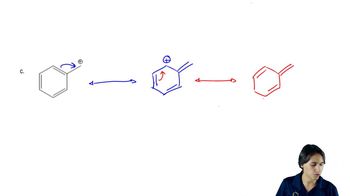
Drawing Resonance Structures

Dianion Stability

A dianion is a species that carries two negative charges. The stability of a dianion is influenced by the ability to delocalize these charges through resonance. In cyclooctatrienyl dianion, the resonance contributors will help determine which structure is more stable and thus contributes more to the overall resonance hybrid, affecting the molecule's reactivity and properties.
Recommended video:
Guided course
03:43
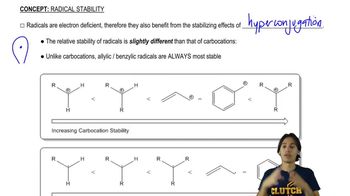
The radical stability trend.

Resonance Hybrid

The resonance hybrid is the actual structure of a molecule that is a weighted average of all its resonance contributors. It represents the most stable arrangement of electrons and is not a single structure but rather a combination of all possible resonance forms. In evaluating which resonance contributor makes the smallest contribution, one must consider factors like charge distribution, octet rule fulfillment, and overall stability of each structure.
Recommended video:
Guided course
03:24
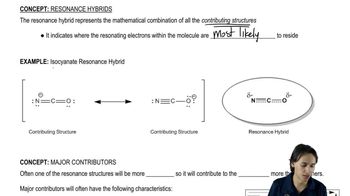
How to draw a resonance hybrid.