Ch. 8 - Delocalized Electrons: Their Effect on Stability, pKa, and the Products of a Reaction • Aromaticity and Electronic Effects: An Introduction to the Reactions of Benzene
Bruice - Organic Chemistry 8th Edition
Bruice8th EditionOrganic ChemistryISBN: 9780135213711Not the one you use?Change textbook
Chapter 9, Problem 103b

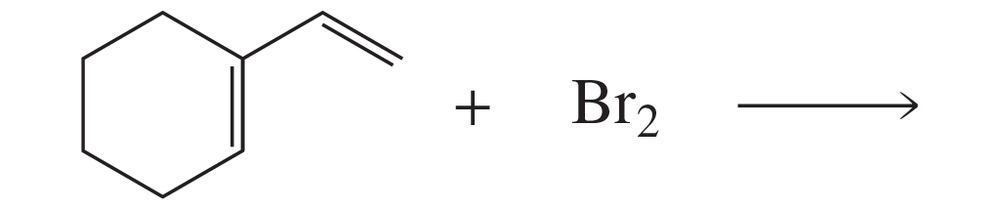
How many stereoisomers of each product could be obtained?
Chemical reaction diagram showing a conjugated system reacting with bromine, indicating potential stereoisomer products.

Verified step by step guidance
1
Step 1: Analyze the reaction type. The given reaction involves an alkene (cyclohexene) reacting with bromine (Br₂). This is a halogenation reaction where bromine adds across the double bond of the alkene.
Step 2: Determine the product structure. Bromine will add to the double bond in an anti-addition manner, resulting in a vicinal dibromide. The product will have two bromine atoms attached to adjacent carbons that were part of the double bond.
Step 3: Assess stereochemistry. Since bromine adds in an anti manner, the two bromine atoms will be added on opposite faces of the cyclohexane ring. This creates stereoisomers due to the spatial arrangement of the bromine atoms.
Step 4: Count possible stereoisomers. The two carbons where bromine is added become stereogenic centers. Each stereogenic center can have two configurations (R or S), leading to a total of 2ⁿ stereoisomers, where n is the number of stereogenic centers. In this case, n = 2, so there are 2² = 4 possible stereoisomers.
Step 5: Verify the stereoisomers. The four stereoisomers include two pairs of enantiomers (mirror images) due to the anti-addition mechanism. These stereoisomers are distinct and can be represented using wedge and dash bonds in the product structure.

Verified video answer for a similar problem:

This video solution was recommended by our tutors as helpful for the problem above.
Video duration:
7m
Was this helpful?

Key Concepts

Here are the essential concepts you must grasp in order to answer the question correctly.

Stereoisomerism

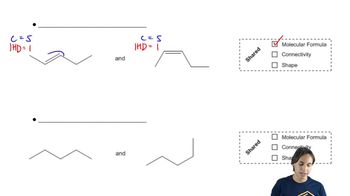
Stereoisomerism refers to the phenomenon where compounds have the same molecular formula and connectivity of atoms but differ in the spatial arrangement of those atoms. This can lead to different physical and chemical properties. The two main types of stereoisomers are enantiomers, which are non-superimposable mirror images, and diastereomers, which are not mirror images of each other.
Recommended video:
Guided course
01:58
Determining when molecules are stereoisomers.

Chirality

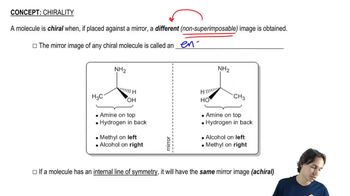
Chirality is a property of a molecule that makes it non-superimposable on its mirror image, much like left and right hands. A chiral molecule typically has at least one carbon atom bonded to four different substituents, creating two distinct enantiomers. Understanding chirality is crucial for determining the number of stereoisomers, as each chiral center can lead to multiple configurations.
Recommended video:
Guided course
05:10
What is chirality?

Counting Stereoisomers

The number of stereoisomers for a compound can be calculated using the formula 2^n, where n is the number of chiral centers in the molecule. This formula accounts for the fact that each chiral center can exist in two configurations (R or S). Additionally, if there are any elements of symmetry in the molecule, they may reduce the total number of unique stereoisomers.
Recommended video:
Guided course
07:07
Electron Counting