Ch. 8 - Delocalized Electrons: Their Effect on Stability, pKa, and the Products of a Reaction • Aromaticity and Electronic Effects: An Introduction to the Reactions of Benzene
Bruice - Organic Chemistry 8th Edition
Bruice8th EditionOrganic ChemistryISBN: 9780135213711Not the one you use?Change textbook
Chapter 9, Problem 90(1)

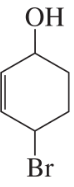
a. How could each of the following compounds be prepared from a hydrocarbon in a single step?
b. What other organic compound would be obtained from each synthesis?
1. Chemical structure of a brominated phenol with a hydroxyl group, illustrating conjugated hydrohalogenation.

Verified step by step guidance
1
Step 1: Analyze the target compound. The structure contains a bromine atom and a hydroxyl group attached to a cyclohexene ring. This suggests that the reaction involves an electrophilic addition to an alkene.
Step 2: Identify the starting hydrocarbon. The simplest hydrocarbon precursor would be cyclohexene, which contains the double bond necessary for the addition reaction.
Step 3: Determine the reagents required for the transformation. To add both a bromine atom and a hydroxyl group in a single step, use bromine (Br₂) in the presence of water (H₂O). This reaction is known as halohydrin formation.
Step 4: Describe the reaction mechanism. The double bond in cyclohexene reacts with bromine to form a bromonium ion intermediate. Water then attacks the more substituted carbon of the bromonium ion, leading to the formation of the halohydrin.
Step 5: Identify the byproduct. The reaction produces hydrobromic acid (HBr) as a byproduct due to the proton transfer during the halohydrin formation process.

Verified video answer for a similar problem:

This video solution was recommended by our tutors as helpful for the problem above.
Video duration:
6m
Was this helpful?

Key Concepts

Here are the essential concepts you must grasp in order to answer the question correctly.

Hydrohalogenation

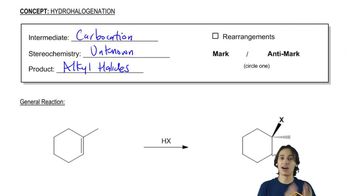
Hydrohalogenation is a chemical reaction where a hydrocarbon reacts with a hydrogen halide (HX) to form an alkyl halide. In the context of aromatic compounds, this reaction can lead to the substitution of hydrogen atoms with halogen atoms, such as bromine. This process is crucial for synthesizing compounds like brominated phenols from hydrocarbons in a single step.
Recommended video:
Guided course
04:07
General properties of hydrohalogenation.

Electrophilic Aromatic Substitution

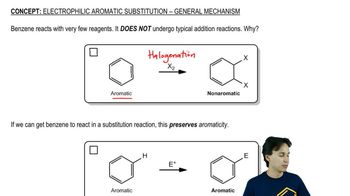
Electrophilic aromatic substitution (EAS) is a fundamental reaction mechanism in organic chemistry where an electrophile replaces a hydrogen atom on an aromatic ring. This mechanism is essential for understanding how bromine can be introduced to a phenolic compound, resulting in the formation of brominated phenols. The presence of the hydroxyl group enhances the reactivity of the aromatic ring towards electrophiles.
Recommended video:

Byproducts in Organic Reactions

In organic synthesis, reactions often yield byproducts alongside the desired product. Understanding the potential byproducts is important for predicting reaction outcomes and optimizing conditions. For example, when synthesizing brominated phenols, other organic compounds, such as hydrogen bromide (HBr), may be produced, which can influence the reaction environment and subsequent steps in the synthesis.
Recommended video:
Guided course
02:17
Identifying organic molecules