Ch. 7 - The Reactions of Alkynes • An Introduction to Multistep Synthesis
Bruice - Organic Chemistry 8th Edition
Bruice8th EditionOrganic ChemistryISBN: 9780135213711Not the one you use?Change textbook
Chapter 8, Problem 34f

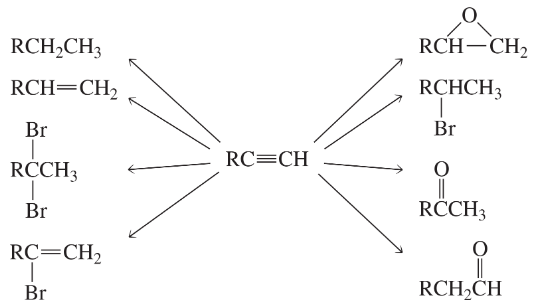
What reagents should be used to carry out the following syntheses?

Verified step by step guidance
1
Identify the starting material and the desired product for each reaction. The starting material is an alkyne (RC≡CH), and the products include alkenes, alkyl halides, and carbonyl compounds.
For the conversion of RC≡CH to RCH₂CH₃, use hydrogenation. The reagent required is H₂ with a metal catalyst such as Pd/C or PtO₂.
To convert RC≡CH to RCH=CH₂, perform a partial hydrogenation. Use H₂ with a Lindlar catalyst to selectively reduce the alkyne to a cis-alkene.
For the transformation of RC≡CH to RCHBrCH₃, use hydrohalogenation. The reagent needed is HBr, which adds across the triple bond to form a bromoalkene.
To synthesize the carbonyl compounds from RC≡CH, use hydration reactions. For example, to form a ketone, use H₂O with H₂SO₄ and HgSO₄ as catalysts to add water across the triple bond, resulting in a ketone after tautomerization.

Verified video answer for a similar problem:

This video solution was recommended by our tutors as helpful for the problem above.
Video duration:
4m
Was this helpful?

Key Concepts

Here are the essential concepts you must grasp in order to answer the question correctly.

Alkyne Reactivity

Alkynes, characterized by a carbon-carbon triple bond, exhibit unique reactivity patterns. They can undergo various reactions such as hydrogenation, halogenation, and hydration. Understanding these reactions is crucial for predicting the products formed when specific reagents are applied to alkynes in synthetic pathways.
Recommended video:
Guided course
09:11
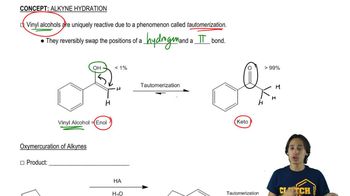
Alkyne Hydration

Electrophilic Addition

Electrophilic addition is a fundamental reaction mechanism in organic chemistry where an electrophile reacts with a nucleophile, typically involving unsaturated compounds like alkenes and alkynes. This concept is essential for understanding how reagents such as bromine or water can add across the triple bond of alkynes, leading to the formation of new functional groups.
Recommended video:
Guided course
09:23
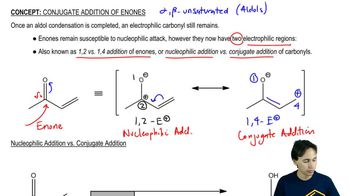
1,2 vs 1,4 Addition

Functional Group Transformation

Functional group transformation refers to the process of converting one functional group into another through chemical reactions. In the context of the provided synthesis question, recognizing how to transform alkynes into alcohols or other derivatives using specific reagents is vital for successful synthesis planning and execution.
Recommended video:
Guided course
02:36
Identifying Functional Groups