Ch. 7 - The Reactions of Alkynes • An Introduction to Multistep Synthesis
Bruice - Organic Chemistry 8th Edition
Bruice8th EditionOrganic ChemistryISBN: 9780135213711Not the one you use?Change textbook
Chapter 8, Problem 8a,b,c

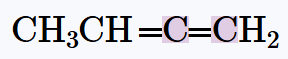
What orbitals are used to form the carbon–carbon s bond between the highlighted carbons?
a.
b.
c.

Verified step by step guidance
1
Identify the highlighted carbons in the structure. In the first image, the highlighted carbons are part of a single bond (σ bond) between two sp3 hybridized carbons. In the second image, the highlighted carbons are part of a double bond (σ and π bonds) between an sp2 hybridized carbon and an sp3 hybridized carbon. In the third image, the highlighted carbons are part of a triple bond (σ and two π bonds) between two sp hybridized carbons.
Understand the hybridization of the carbons involved. Hybridization determines the type of orbitals used in bonding. For sp3 hybridized carbons, the σ bond is formed using sp3 orbitals. For sp2 hybridized carbons, the σ bond is formed using sp2 orbitals, and the π bond is formed using unhybridized p orbitals. For sp hybridized carbons, the σ bond is formed using sp orbitals, and the π bonds are formed using unhybridized p orbitals.
Analyze the bonding in the first image. The carbon-carbon σ bond is formed by the overlap of two sp3 orbitals, as both carbons are sp3 hybridized.
Analyze the bonding in the second image. The carbon-carbon σ bond is formed by the overlap of an sp2 orbital from one carbon and an sp3 orbital from the other carbon. The π bond is formed by the side-by-side overlap of unhybridized p orbitals from the sp2 hybridized carbon.
Analyze the bonding in the third image. The carbon-carbon σ bond is formed by the overlap of two sp orbitals, and the two π bonds are formed by the side-by-side overlap of unhybridized p orbitals from each sp hybridized carbon.

Verified video answer for a similar problem:

This video solution was recommended by our tutors as helpful for the problem above.
Was this helpful?

Key Concepts

Here are the essential concepts you must grasp in order to answer the question correctly.

Hybridization

Hybridization is the process by which atomic orbitals mix to form new hybrid orbitals that are suitable for the pairing of electrons to form chemical bonds. In carbon, the most common hybridizations are sp3, sp2, and sp, which correspond to different types of bonding and molecular geometries. Understanding hybridization is crucial for determining the types of bonds formed between carbon atoms.
Recommended video:
Guided course
10:43
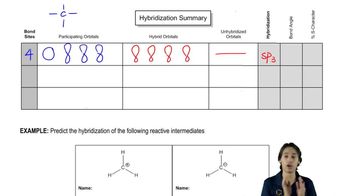
Using bond sites to predict hybridization

Sigma Bonds

A sigma (σ) bond is a type of covalent bond formed by the head-on overlap of atomic orbitals. In the case of carbon–carbon bonds, the overlap can occur between hybrid orbitals (like sp3 or sp2) or between an s orbital and a hybrid orbital. Sigma bonds are characterized by their cylindrical symmetry around the bond axis and are the first bonds formed between two atoms.
Recommended video:
Guided course
01:05
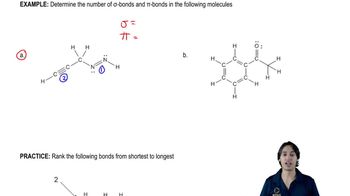
Sigma bonds and pi bonds

Orbital Overlap

Orbital overlap refers to the extent to which atomic orbitals from two atoms share the same space when forming a bond. The greater the overlap, the stronger the bond. In carbon–carbon bonds, understanding how the specific orbitals overlap (such as s, p, or hybrid orbitals) is essential for predicting bond strength and molecular structure.
Recommended video:
Guided course
08:41
Review of Molecular Orbitals