Ch. 7 - The Reactions of Alkynes • An Introduction to Multistep Synthesis
Bruice - Organic Chemistry 8th Edition
Bruice8th EditionOrganic ChemistryISBN: 9780135213711Not the one you use?Change textbook
Chapter 8, Problem 29c

What is the major product obtained from the reaction of each of the following compounds with excess HCl?
c. CH3CH2C☰CCH2CH2CH3

Verified step by step guidance
1
Identify the functional group in the given compound. The compound contains a terminal alkyne group (C≡C) at the third carbon position.
Understand the reaction mechanism. When a terminal alkyne reacts with excess HCl, the reaction proceeds via Markovnikov's addition of HCl across the triple bond. This means the hydrogen (H) will add to the carbon with more hydrogens, and the chlorine (Cl) will add to the carbon with fewer hydrogens.
In the first step, one equivalent of HCl adds to the alkyne, converting the triple bond into a double bond. This forms a vinyl halide intermediate (CH3CH2CH=CHClCH2CH2CH3).
In the second step, the excess HCl reacts with the vinyl halide intermediate. Another molecule of HCl adds across the double bond, following Markovnikov's rule again. This results in a geminal dihalide (CH3CH2CHCl2CH2CH2CH3), where both chlorine atoms are attached to the same carbon.
Verify the major product. The major product is the geminal dihalide formed after the complete addition of excess HCl to the terminal alkyne.

Verified video answer for a similar problem:

This video solution was recommended by our tutors as helpful for the problem above.
Video duration:
5m
Was this helpful?

Key Concepts

Here are the essential concepts you must grasp in order to answer the question correctly.

Alkyne Reactivity

Alkynes are hydrocarbons containing a carbon-carbon triple bond, which makes them more reactive than alkenes and alkanes. When treated with strong acids like HCl, alkynes can undergo protonation to form more stable carbocations, leading to further reactions such as addition. Understanding the mechanism of alkyne reactivity is crucial for predicting the products formed in acid-catalyzed reactions.
Recommended video:
Guided course
09:11
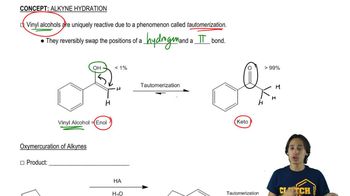
Alkyne Hydration

Markovnikov's Rule

Markovnikov's Rule states that in the addition of HX (where X is a halogen) to an alkene or alkyne, the hydrogen atom will attach to the carbon with the greater number of hydrogen atoms already attached. This principle helps predict the regioselectivity of the reaction, guiding the formation of the major product when excess HCl reacts with alkynes.
Recommended video:
Guided course
03:54
The 18 and 16 Electron Rule

Carbocation Stability

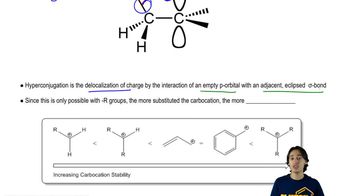
Carbocations are positively charged carbon species that can form during reactions involving alkenes and alkynes. The stability of a carbocation is influenced by the number of alkyl groups attached to the positively charged carbon; more alkyl groups lead to greater stability due to hyperconjugation and inductive effects. Recognizing the stability of potential carbocations is essential for determining the major product in reactions with HCl.
Recommended video:
Guided course
05:58
Determining Carbocation Stability