Ch. 7 - The Reactions of Alkynes • An Introduction to Multistep Synthesis
Bruice - Organic Chemistry 8th Edition
Bruice8th EditionOrganic ChemistryISBN: 9780135213711Not the one you use?Change textbook
Chapter 8, Problem 52a

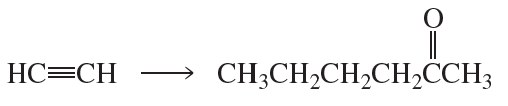
Show how each of the following compounds can be prepared using the given starting material, any needed inorganic reagents, and any ­organic compound that has no more than four carbons:
a. Reaction scheme showing the conversion of an alkyne to a longer carbon chain compound with a carbonyl group.

Verified step by step guidance
1
Analyze the target compound and identify the functional groups present. Determine the transformations required to convert the starting material into the target compound.
Break down the synthesis into smaller steps. Identify the reagents and conditions needed for each transformation, ensuring that all organic intermediates have no more than four carbons.
For each step, write the chemical equation or reaction mechanism, showing how the starting material is converted into intermediates and then into the final product.
Verify that the proposed synthesis is feasible by checking for compatibility of reagents and reaction conditions. Ensure that no side reactions interfere with the desired pathway.
Summarize the complete synthetic route, listing all reagents, intermediates, and conditions in the correct sequence to achieve the target compound from the given starting material.

Verified video answer for a similar problem:

This video solution was recommended by our tutors as helpful for the problem above.
Video duration:
2m
Was this helpful?

Key Concepts

Here are the essential concepts you must grasp in order to answer the question correctly.

Functional Groups

Functional groups are specific groups of atoms within molecules that are responsible for the characteristic chemical reactions of those molecules. Understanding the functional groups present in the starting material and the target compounds is essential for determining the appropriate reactions and reagents needed for synthesis.
Recommended video:
Guided course
02:36
Identifying Functional Groups

Reaction Mechanisms

Reaction mechanisms describe the step-by-step process by which reactants are converted into products. Familiarity with common mechanisms, such as nucleophilic substitution or elimination reactions, is crucial for predicting how to transform the starting material into the desired compounds using the specified reagents.
Recommended video:
Guided course
02:16
Heck Reaction Mechanism

Synthesis Strategies

Synthesis strategies involve planning a series of chemical reactions to construct a target molecule from available starting materials. This includes selecting appropriate reagents, considering reaction conditions, and ensuring that the transformations adhere to the constraints of using compounds with no more than four carbons.
Recommended video:
1:16
Synthesis of Amino Acids: Strecker Synthesis Example 1