Ch. 7 - The Reactions of Alkynes • An Introduction to Multistep Synthesis
Bruice - Organic Chemistry 8th Edition
Bruice8th EditionOrganic ChemistryISBN: 9780135213711Not the one you use?Change textbook
Chapter 8, Problem 46b

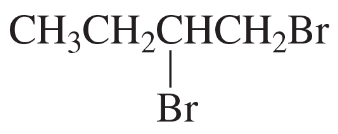
How can the following compounds be prepared using ethyne as the starting material?
b.

Verified step by step guidance
1
Step 1: Begin with ethyne (C≡CH) as the starting material. Ethyne is a simple alkyne that can undergo addition reactions to form more complex molecules.
Step 2: Perform a hydrohalogenation reaction with HBr to convert ethyne into bromoethene (CH2=CHBr). This reaction involves the addition of HBr across the triple bond, following Markovnikov's rule.
Step 3: Carry out a second hydrohalogenation reaction with HBr to convert bromoethene into 1,2-dibromoethane (CH2Br-CH2Br). This step involves the addition of another molecule of HBr across the double bond.
Step 4: Perform a Wurtz reaction or similar coupling reaction to extend the carbon chain. React 1,2-dibromoethane with sodium metal in the presence of an appropriate solvent to form a longer alkyl chain, such as CH3CH2CH2Br.
Step 5: Introduce the second bromine atom at the desired position using a free radical bromination reaction. React CH3CH2CH2Br with Br2 in the presence of light or heat to form the final compound, CH3CH2CHCH2Br, with bromine atoms at the correct positions.

Verified video answer for a similar problem:

This video solution was recommended by our tutors as helpful for the problem above.
Video duration:
5m
Was this helpful?

Key Concepts

Here are the essential concepts you must grasp in order to answer the question correctly.

Ethyne as a Building Block

Ethyne, also known as acetylene, is a simple alkyne that serves as a versatile building block in organic synthesis. Its triple bond allows for various reactions, including addition reactions with electrophiles, which can lead to the formation of more complex molecules. Understanding how to manipulate ethyne's reactivity is crucial for synthesizing a wide range of organic compounds.
Recommended video:
Guided course
16:59
Building a molecular sentence

Reactions of Alkynes

Alkynes undergo several key reactions, including hydrogenation, halogenation, and hydroboration-oxidation. These reactions can modify the triple bond to form double bonds or single bonds, allowing for the construction of different functional groups. Familiarity with these reaction mechanisms is essential for predicting the products formed when ethyne is used as a starting material.
Recommended video:
Guided course
01:01
General properties of double addition reactions to alkynes.

Functional Group Transformations

Functional group transformations involve converting one functional group into another, which is a fundamental aspect of organic synthesis. By understanding how to perform these transformations, chemists can design pathways to create desired compounds from simpler starting materials like ethyne. This concept is vital for planning synthetic routes and achieving specific molecular architectures.
Recommended video:
Guided course
02:36
Identifying Functional Groups