Ch. 6 - The Reactions of Alkenes • The Stereochemistry of Addition Reactions
Bruice - Organic Chemistry 8th Edition
Bruice8th EditionOrganic ChemistryISBN: 9780135213711Not the one you use?Change textbook
Chapter 7, Problem 58j

What is the major product of the reaction of 2-methyl-2-butene with each of the following reagents?
j. Br2/CH3OH

Verified step by step guidance
1
Identify the type of reaction: The reaction involves 2-methyl-2-butene (an alkene) reacting with bromine (Br₂) in the presence of methanol (CH₃OH). This is an electrophilic addition reaction where the alkene undergoes halogenation in the presence of a nucleophile (methanol).
Understand the mechanism: The π-electrons of the double bond in 2-methyl-2-butene attack one of the bromine atoms in Br₂, forming a bromonium ion intermediate. This intermediate is a three-membered ring with a positive charge on the bromine atom.
Determine the role of methanol: Methanol (CH₃OH) acts as a nucleophile in this reaction. It will attack the more substituted carbon of the bromonium ion (due to Markovnikov's rule and the stability of the carbocation-like transition state).
Predict the product: The methanol adds to the more substituted carbon, while the bromine atom from the bromonium ion remains attached to the less substituted carbon. This results in the formation of a bromomethoxy product.
Consider stereochemistry: Since the bromonium ion intermediate is cyclic, the attack by methanol occurs from the opposite side (anti-addition). This leads to a product with anti stereochemistry, where the bromine and methoxy groups are on opposite sides of the molecule.

Verified video answer for a similar problem:

This video solution was recommended by our tutors as helpful for the problem above.
Video duration:
2m
Was this helpful?

Key Concepts

Here are the essential concepts you must grasp in order to answer the question correctly.

Electrophilic Addition Reactions

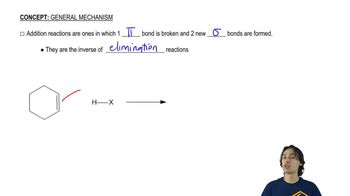
Electrophilic addition reactions involve the addition of electrophiles to alkenes, where the double bond acts as a nucleophile. In the case of 2-methyl-2-butene, the double bond can react with electrophiles like Br2, leading to the formation of a bromonium ion intermediate. This intermediate can then be attacked by nucleophiles, such as methanol (CH3OH), resulting in the formation of a product with both bromine and methoxy groups.
Recommended video:
Guided course
05:39
Features of Addition Mechanisms.

Regioselectivity

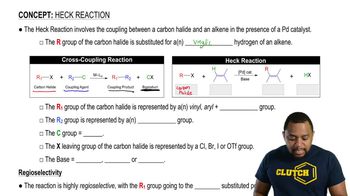
Regioselectivity refers to the preference of a chemical reaction to yield one structural isomer over others when multiple possibilities exist. In the reaction of 2-methyl-2-butene with Br2 and CH3OH, the regioselectivity will determine which carbon atom of the alkene will bond with the bromine and which will bond with the methanol, leading to the major product. Understanding the stability of intermediates helps predict the favored pathway.
Recommended video:
Guided course
05:09
Heck Reaction

Stereochemistry

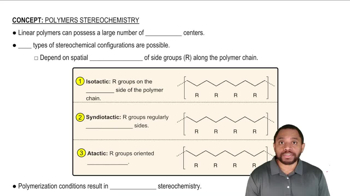
Stereochemistry is the study of the spatial arrangement of atoms in molecules and how this affects their chemical behavior. In the reaction of 2-methyl-2-butene with Br2 and CH3OH, the formation of a bromonium ion can lead to different stereochemical outcomes depending on how the nucleophile attacks the intermediate. This can result in the formation of different stereoisomers, which is crucial for determining the final product's structure.
Recommended video:
1:38
Polymer Stereochemistry Concept 1