Ch. 6 - The Reactions of Alkenes • The Stereochemistry of Addition Reactions
Bruice - Organic Chemistry 8th Edition
Bruice8th EditionOrganic ChemistryISBN: 9780135213711Not the one you use?Change textbook
Chapter 7, Problem 81a

What is the major product of each of the following reactions?
a. Chemical reaction showing the addition of Br2 to an alkene, producing a halohydrin in dichloromethane.

Verified step by step guidance
1
Analyze the reaction conditions: The reagent Br₂ in CH₂Cl₂ indicates a bromination reaction, specifically an electrophilic addition to the double bond.
Identify the reactive site: The double bond in the molecule is the site of electrophilic attack by Br₂. The π-electrons of the double bond will interact with Br₂, leading to the formation of a bromonium ion intermediate.
Determine the regioselectivity: Bromination of alkenes typically follows Markovnikov's rule, where the bromonium ion intermediate is attacked by the bromide ion at the more substituted carbon of the double bond.
Consider stereochemistry: Bromination of alkenes proceeds via anti-addition, meaning the two bromine atoms will add to opposite faces of the double bond, resulting in a trans product.
Draw the major product: The major product will have bromine atoms added to the two carbons of the double bond, with anti stereochemistry. Ensure the hydroxyl group remains unaffected as it is not reactive under these conditions.

Verified video answer for a similar problem:

This video solution was recommended by our tutors as helpful for the problem above.
Video duration:
6m
Was this helpful?

Key Concepts

Here are the essential concepts you must grasp in order to answer the question correctly.

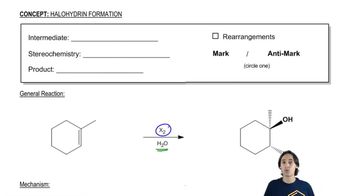
Halohydrin Formation

Halohydrin formation is a reaction where an alkene reacts with a halogen (like Br2) in the presence of water or an alcohol, leading to the formation of a halohydrin. In this process, the halogen adds to one carbon of the double bond, while a hydroxyl group (OH) adds to the adjacent carbon, resulting in a compound that contains both a halogen and a hydroxyl group.
Recommended video:
Guided course
01:44
General properties of halohydrin formation.

Regioselectivity

Regioselectivity refers to the preference of a chemical reaction to yield one structural isomer over others when multiple products are possible. In the case of halohydrin formation, the regioselectivity is influenced by the stability of the carbocation intermediate formed during the reaction, which can lead to Markovnikov or anti-Markovnikov products depending on the conditions.
Recommended video:
Guided course
05:09
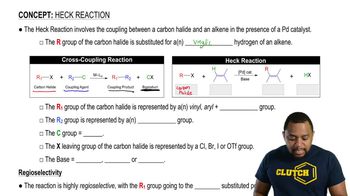
Heck Reaction

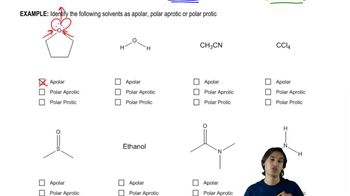
Solvent Effects

The choice of solvent can significantly influence the outcome of a chemical reaction. In this case, CH2Cl2 (dichloromethane) is a non-polar solvent that can stabilize the halogen and facilitate the reaction without participating in it. The solvent's properties can affect the reaction mechanism and the stability of intermediates, ultimately impacting the major product formed.
Recommended video:
Guided course
01:16
Identification of polarity in solvents