Ch. 6 - The Reactions of Alkenes • The Stereochemistry of Addition Reactions
Bruice - Organic Chemistry 8th Edition
Bruice8th EditionOrganic ChemistryISBN: 9780135213711Not the one you use?Change textbook
Chapter 7, Problem 28c.d

What alkene would you treat with a peroxyacid in order to obtain each of the epoxides in Problem 27?
c. 2,2,3,3-tetramethyloxirane
d. 2,3-epoxy-2-methylpentane

Verified step by step guidance
1
Identify the structure of the epoxide product. For part (c), the epoxide is 2,2,3,3-tetramethyloxirane, which has a three-membered ring with two methyl groups attached to each of the carbons in the ring. For part (d), the epoxide is 2,3-epoxy-2-methylpentane, which has a three-membered ring with a methyl group on carbon 2 and a pentane chain attached to carbon 3.
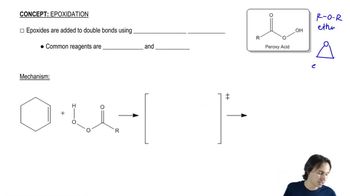
Recall that epoxides are formed by the reaction of an alkene with a peroxyacid (e.g., mCPBA). The oxygen from the peroxyacid adds across the double bond of the alkene to form the three-membered epoxide ring.
Determine the alkene precursor for each epoxide. For part (c), the alkene must have a double bond between the two carbons that will form the epoxide ring, with two methyl groups attached to each of these carbons. This suggests the alkene is 2,3-dimethyl-2-butene.
For part (d), the alkene must have a double bond between carbons 2 and 3, with a methyl group on carbon 2 and a pentane chain on carbon 3. This suggests the alkene is 2-methyl-2-pentene.
Verify the structures of the proposed alkenes by mentally performing the epoxidation reaction. Ensure that the oxygen from the peroxyacid would add across the double bond to form the desired epoxide in each case.

Verified video answer for a similar problem:

This video solution was recommended by our tutors as helpful for the problem above.
Video duration:
5m
Was this helpful?

Key Concepts

Here are the essential concepts you must grasp in order to answer the question correctly.

Alkenes and Their Reactivity

Alkenes are hydrocarbons that contain at least one carbon-carbon double bond, which makes them reactive species in organic chemistry. Their reactivity allows them to undergo various reactions, including electrophilic additions and oxidation. Understanding the structure and stability of alkenes is crucial for predicting the products of reactions, such as the formation of epoxides.
Recommended video:
2:09
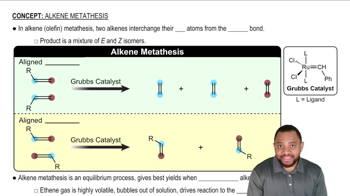
Alkene Metathesis Concept 1

Peroxyacids and Epoxidation

Peroxyacids, such as m-chloroperbenzoic acid (MCPBA), are strong oxidizing agents that can convert alkenes into epoxides through a reaction known as epoxidation. This reaction involves the addition of an oxygen atom across the double bond of the alkene, forming a three-membered cyclic ether. Recognizing the mechanism of this reaction is essential for determining which alkene will yield a specific epoxide.
Recommended video:
Guided course
02:19
General properties of epoxidation.

Stereochemistry of Epoxides

Epoxides are cyclic ethers that exhibit unique stereochemical properties due to their three-membered ring structure. The stereochemistry of the starting alkene influences the stereochemistry of the resulting epoxide. Understanding how substituents on the alkene affect the formation and configuration of the epoxide is vital for predicting the correct alkene to use in the synthesis of specific epoxides.
Recommended video:
1:38
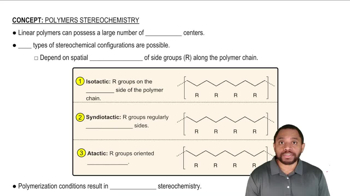
Polymer Stereochemistry Concept 1