Ch. 6 - The Reactions of Alkenes • The Stereochemistry of Addition Reactions
Bruice - Organic Chemistry 8th Edition
Bruice8th EditionOrganic ChemistryISBN: 9780135213711Not the one you use?Change textbook
Chapter 7, Problem 57b

Identify the electrophile and the nucleophile in each of the following reaction steps and then draw curved arrows to illustrate the bond-making and bondbreaking processes.
b.

Verified step by step guidance
1
Step 1: Identify the electrophile and nucleophile in the reaction. The electrophile is the H atom in H-Br because it is electron-deficient and can accept electrons. The nucleophile is the π-electrons in the double bond of CH3CH=CH2 because they are electron-rich and can donate electrons.
Step 2: Analyze the bond-breaking process. The bond between H and Br in H-Br breaks heterolytically, meaning the electrons from the bond move entirely to Br, forming Br⁻. Represent this with a curved arrow starting from the bond between H and Br and pointing toward Br.
Step 3: Analyze the bond-making process. The π-electrons in the double bond of CH3CH=CH2 attack the H atom from H-Br, forming a new bond between the H atom and one of the carbons in the double bond. Represent this with a curved arrow starting from the π-electrons in the double bond and pointing toward the H atom.
Step 4: Determine the intermediate formed. After the bond-making and bond-breaking processes, a carbocation intermediate is formed. The carbon that does not bond with the H atom becomes positively charged (CH3CH-CH3⁺).
Step 5: Draw the curved arrows and intermediates clearly. Ensure the curved arrows illustrate the movement of electrons during the bond-making and bond-breaking processes, and show the formation of Br⁻ and the carbocation intermediate CH3CH-CH3⁺.

Verified video answer for a similar problem:

This video solution was recommended by our tutors as helpful for the problem above.
Video duration:
3m
Was this helpful?

Key Concepts

Here are the essential concepts you must grasp in order to answer the question correctly.

Electrophiles

Electrophiles are species that accept electrons during a chemical reaction. They are typically positively charged or neutral molecules with an electron-deficient atom, making them attractive to nucleophiles. In organic reactions, common electrophiles include carbocations, carbonyl compounds, and halogens. Understanding the nature of electrophiles is crucial for predicting reaction pathways and mechanisms.
Recommended video:
Guided course
03:
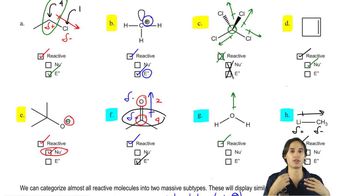
Nucleophile or Electrophile

Nucleophiles

Nucleophiles are electron-rich species that donate electrons to electrophiles during a reaction. They can be negatively charged ions or neutral molecules with lone pairs of electrons. Common examples include hydroxide ions, alkoxides, and amines. Recognizing nucleophiles is essential for understanding how they interact with electrophiles to form new bonds in organic reactions.
Recommended video:
Guided course
08:27
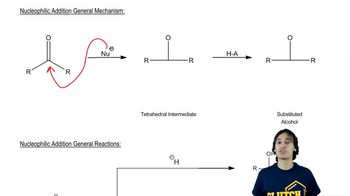
Nucleophilic Addition

Curved Arrows in Mechanisms

Curved arrows are used in organic chemistry to represent the movement of electrons during chemical reactions. A curved arrow starts at the source of electron density (like a nucleophile) and points to the destination (like an electrophile), indicating bond formation or breaking. This notation helps visualize reaction mechanisms and is vital for illustrating how reactants transform into products.
Recommended video:
Guided course
04:32
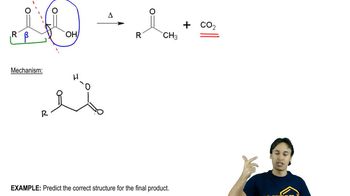
General Mechanism