Ch. 6 - The Reactions of Alkenes • The Stereochemistry of Addition Reactions
Bruice - Organic Chemistry 8th Edition
Bruice8th EditionOrganic ChemistryISBN: 9780135213711Not the one you use?Change textbook
Chapter 7, Problem 54

Explain why 3-methylcyclohexene should not be used as the starting material in Problem 52b.

Verified step by step guidance
1
Analyze the structure of 3-methylcyclohexene: It is an alkene with a methyl group attached to the cyclohexene ring. The double bond is located within the ring, making it a cyclic alkene.
Consider the reactivity of 3-methylcyclohexene: Alkenes are prone to addition reactions, and the position of the double bond can influence the regioselectivity and stereoselectivity of the reaction.
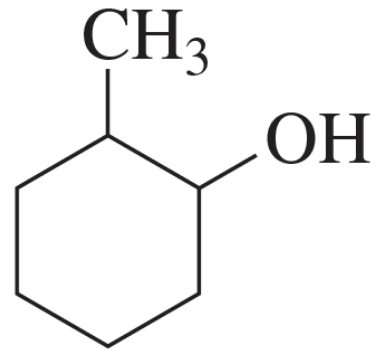
Compare the structure of 3-methylcyclohexene to the desired product in Problem 52b: The image provided shows a structure with a hydroxyl group (-OH) attached to the ring. This suggests that the reaction involves functional group transformation, likely requiring specific regioselectivity.
Evaluate why 3-methylcyclohexene is unsuitable: The methyl group on the cyclohexene ring can cause steric hindrance, which may interfere with the reaction mechanism or lead to undesired side products. Additionally, the position of the double bond may not align with the desired regioselectivity for the hydroxyl group addition.
Conclude that a different starting material, such as cyclohexene without the methyl group, would be more appropriate for achieving the desired product in Problem 52b. This ensures better control over the reaction pathway and minimizes steric hindrance.

Verified video answer for a similar problem:

This video solution was recommended by our tutors as helpful for the problem above.
Video duration:
3m
Was this helpful?

Key Concepts

Here are the essential concepts you must grasp in order to answer the question correctly.

Cycloalkenes

Cycloalkenes are cyclic hydrocarbons that contain at least one carbon-carbon double bond. In the case of 3-methylcyclohexene, the double bond is part of a six-membered ring, which can influence the reactivity and stability of the compound. Understanding the structure and properties of cycloalkenes is crucial for predicting their behavior in chemical reactions.
Recommended video:
Guided course
01:11
How to find the root name for cycloalkanes

Substitution Reactions

Substitution reactions involve the replacement of one atom or group in a molecule with another. In organic chemistry, the nature of the substituents and the structure of the starting material can significantly affect the reaction pathway and product formation. Recognizing how 3-methylcyclohexene might participate in substitution reactions is essential for evaluating its suitability as a starting material.
Recommended video:
Guided course
01:34
Recognizing Substitution Reactions.

Steric Hindrance

Steric hindrance refers to the repulsion between bulky groups in a molecule that can impede reactions. In 3-methylcyclohexene, the presence of the methyl group can create steric strain, affecting the accessibility of the double bond for reactions. Understanding steric effects is vital for predicting the feasibility of using certain compounds in synthetic pathways.
Recommended video:
Guided course
02:53
Understanding steric effects.