Ch. 6 - The Reactions of Alkenes • The Stereochemistry of Addition Reactions
Bruice - Organic Chemistry 8th Edition
Bruice8th EditionOrganic ChemistryISBN: 9780135213711Not the one you use?Change textbook
Chapter 7, Problem 76c,d

c. What is the electrophile in the first step?
d. What is the nucleophile in the first step?

Verified step by step guidance
1
Identify the reaction mechanism being discussed. For example, is it an SN1, SN2, E1, E2, or another type of reaction? This will help determine the roles of the electrophile and nucleophile in the first step.
Understand the definition of an electrophile: An electrophile is a species that accepts a pair of electrons during a reaction. It is often electron-deficient and can be positively charged, partially positively charged, or have an empty orbital.
Understand the definition of a nucleophile: A nucleophile is a species that donates a pair of electrons to form a new bond. It is often electron-rich and can be negatively charged, neutral with lone pairs, or have π-electrons.
Examine the reactants in the first step of the reaction. Look for the species that is electron-deficient (electrophile) and the species that is electron-rich (nucleophile). For example, in a reaction between an alkyl halide and a hydroxide ion, the alkyl halide (with a partial positive charge on the carbon attached to the halogen) is the electrophile, and the hydroxide ion (with a lone pair of electrons) is the nucleophile.
Confirm the roles of the electrophile and nucleophile by analyzing the flow of electrons in the reaction mechanism. Use curved arrows to show how the nucleophile donates electrons to the electrophile, forming a new bond or intermediate.

Verified video answer for a similar problem:

This video solution was recommended by our tutors as helpful for the problem above.
Video duration:
3m
Was this helpful?

Key Concepts

Here are the essential concepts you must grasp in order to answer the question correctly.

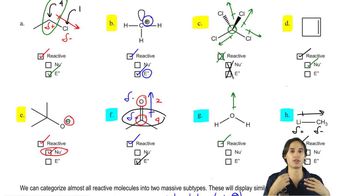
Electrophiles

Electrophiles are species that accept electrons during a chemical reaction. They are typically positively charged or neutral molecules with an electron-deficient atom, making them attractive to nucleophiles. In organic reactions, electrophiles often participate in the formation of new bonds by reacting with nucleophiles, which donate electrons.
Recommended video:
Guided course
03:
Nucleophile or Electrophile

Nucleophiles

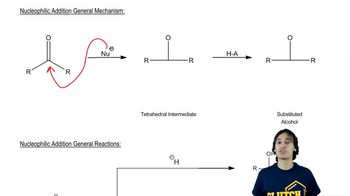
Nucleophiles are electron-rich species that donate a pair of electrons to form a chemical bond. They can be negatively charged ions or neutral molecules with lone pairs of electrons. In organic chemistry, nucleophiles are crucial in substitution and addition reactions, where they attack electrophiles to create new compounds.
Recommended video:
Guided course
08:27
Nucleophilic Addition

Reaction Mechanism

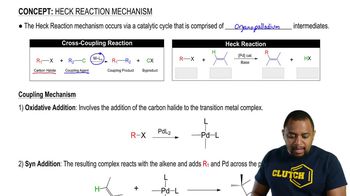
A reaction mechanism is a step-by-step description of the pathway taken during a chemical reaction. It outlines the sequence of events, including the roles of electrophiles and nucleophiles, and helps predict the products formed. Understanding the mechanism is essential for grasping how reactants transform into products and for identifying key intermediates.
Recommended video:
Guided course
02:16
Heck Reaction Mechanism