How does the first step in the reaction of propene with Br2 differ from the first step in the reaction of propene with HBr?
Ch. 6 - The Reactions of Alkenes • The Stereochemistry of Addition Reactions
All textbooks
Bruice 8th Edition
Ch. 6 - The Reactions of Alkenes • The Stereochemistry of Addition Reactions
Problem 21b
Bruice 8th Edition
Ch. 6 - The Reactions of Alkenes • The Stereochemistry of Addition Reactions
Problem 21bChapter 7, Problem 21b
To understand why Br− adds to a carbon of the bromonium ion rather than to the positively charged bromine, draw the product that would be obtained if Br− did add to bromine.
Verified step by step guidance1
Draw the structure of the bromonium ion intermediate. This is formed when an alkene reacts with Br₂, resulting in a three-membered ring where the bromine atom is bonded to both carbons of the former double bond, and the bromine carries a positive charge.
Consider the nucleophilic attack by Br⁻. Recall that nucleophiles are attracted to electrophilic centers, which are typically positively charged or electron-deficient. In the bromonium ion, the carbons in the three-membered ring are partially positive due to the electron-withdrawing nature of the bromine atom.
Analyze the possibility of Br⁻ attacking the positively charged bromine atom instead of the carbons. If Br⁻ were to attack the bromine atom, it would result in a structure where the bromine atom has four bonds, which violates the octet rule and is not chemically feasible.
Draw the hypothetical product that would result if Br⁻ added to the bromine atom. This structure would be highly unstable and not observed in practice. Highlight that this is why Br⁻ does not attack the bromine atom.
Conclude that Br⁻ adds to one of the carbons of the bromonium ion instead, leading to the formation of a vicinal dibromide. This pathway is both energetically favorable and consistent with the observed product of the reaction.

Verified video answer for a similar problem:
This video solution was recommended by our tutors as helpful for the problem above.
Video duration:
1mWas this helpful?
Key Concepts
Here are the essential concepts you must grasp in order to answer the question correctly.
Bromonium Ion
A bromonium ion is a cyclic intermediate formed during the electrophilic addition of bromine (Br2) to an alkene. In this structure, one bromine atom forms a three-membered ring with the alkene, creating a positively charged bromine atom. This intermediate is crucial for understanding the regioselectivity of the addition reaction, as it influences where nucleophiles, like Br−, will attack.
Recommended video:
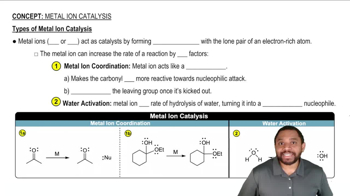
Metal Ion Catalysis Concept 1
Nucleophilic Attack
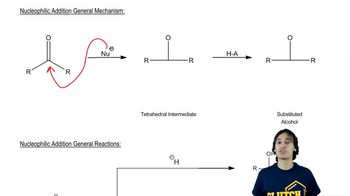
Nucleophilic attack refers to the process where a nucleophile, which is a species with a lone pair of electrons or a negative charge, donates its electrons to an electrophile, forming a new bond. In the context of the bromonium ion, Br− acts as the nucleophile that attacks the more stable carbon atom of the ion, rather than the positively charged bromine, which is less favorable due to steric and electronic factors.
Recommended video:
Guided course
Nucleophilic Addition
Regioselectivity
Regioselectivity is the preference of a chemical reaction to yield one structural isomer over others when multiple products are possible. In the case of bromonium ion formation, the regioselectivity is determined by the stability of the resulting carbocation and the sterics involved in the nucleophilic attack. Understanding regioselectivity helps predict the major product of the reaction when Br− adds to the bromonium ion.
Recommended video:
Guided course
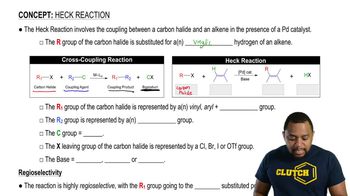
Heck Reaction
Related Practice
Textbook Question
1
views
Textbook Question
Each of the following reactions has two nucleophiles that could add to the intermediate formed by the reaction of the alkene with an electrophile. What is the major product of each reaction?
a.
1
views
Textbook Question
What is the major product obtained from hydroboration–oxidation of the following alkenes?
a. 2-methyl-2-butene
1
views
Textbook Question
What will be the product of the preceding reaction if HBr is used in place of Br2?
1
views
Textbook Question
Each of the following reactions has two nucleophiles that could add to the intermediate formed by the reaction of the alkene with an electrophile. What is the major product of each reaction?
b.
2
views
Textbook Question
Why are Na+ and K+ unable to form covalent bonds?
1
views