
Ch. 6 - The Reactions of Alkenes • The Stereochemistry of Addition Reactions
Bruice - Organic Chemistry 8th Edition
Bruice8th EditionOrganic ChemistryISBN: 9780135213711Not the one you use?Change textbook
Chapter 7, Problem 71

1-Methylcyclohexene forms two products when it reacts with bromine in methanol.
a. Draw the mechanism for the formation of the products.
b. Describe their stereochemical relationship—that is, are they enantiomers or diastereomers?

Verified step by step guidance
1
Step 1: Identify the reaction type. This is an electrophilic addition reaction where bromine (Br2) adds across the double bond of 1-methylcyclohexene.
Step 2: Draw the initial interaction. The π bond of the alkene attacks a bromine molecule, forming a cyclic bromonium ion intermediate and releasing a bromide ion (Br-).
Step 3: Consider the role of methanol. The methanol (CH3OH) acts as a nucleophile and attacks the more substituted carbon of the bromonium ion, opening the ring and forming a bromohydrin.
Step 4: Draw the products. The reaction results in two products: one where the methanol attacks from the opposite side of the bromine (anti-addition), leading to a trans product, and another where it attacks from the same side, leading to a cis product.
Step 5: Analyze the stereochemical relationship. The two products are diastereomers because they are not mirror images of each other and have different physical properties.

Verified video answer for a similar problem:

This video solution was recommended by our tutors as helpful for the problem above.
Video duration:
9m
Was this helpful?

Key Concepts

Here are the essential concepts you must grasp in order to answer the question correctly.

Electrophilic Addition Mechanism

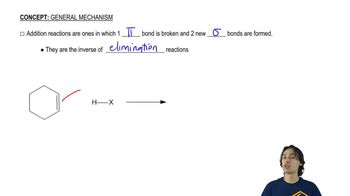
The reaction of 1-methylcyclohexene with bromine in methanol involves an electrophilic addition mechanism. In this process, the double bond of the alkene acts as a nucleophile, attacking the electrophilic bromine molecule, leading to the formation of a cyclic bromonium ion intermediate. This intermediate is then attacked by methanol, resulting in the formation of bromomethoxy products.
Recommended video:
Guided course
05:39
Features of Addition Mechanisms.

Stereochemistry

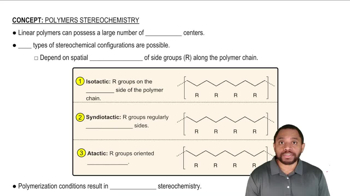
Stereochemistry refers to the study of the spatial arrangement of atoms in molecules and how this affects their chemical behavior. In the context of the products formed from the reaction, understanding stereochemistry is crucial to determine whether the products are enantiomers (non-superimposable mirror images) or diastereomers (stereoisomers that are not mirror images).
Recommended video:
1:38
Polymer Stereochemistry Concept 1

Product Analysis

After the reaction, analyzing the products involves determining their structural formulas and stereochemical configurations. This analysis helps in identifying the relationship between the products, whether they are enantiomers or diastereomers, based on their spatial arrangement and the presence of chiral centers. This is essential for understanding the implications of the reaction in organic synthesis.
Recommended video:
Guided course
11:07
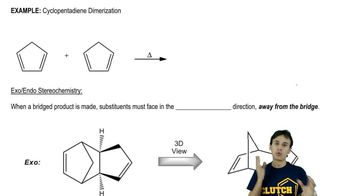
Bridged-Products
Related Practice
Textbook Question

Draw the product or products that will be obtained from the reaction of cis-2-butene and trans-2-butene with each of the following reagents. If a product can exist as stereoisomers, show which stereoisomers are formed.

3. a peroxyacid

1
views
Textbook Question

Draw the products of the following reactions. If the products can exist as stereoisomers, show which stereoisomers are formed.

c.

2
views
Textbook Question

Draw the product or products that will be obtained from the reaction of cis-2-butene and trans-2-butene with each of the following reagents. If a product can exist as stereoisomers, show which stereoisomers are formed.

4. Br2 in CH2Cl2

Textbook Question

Draw the product or products that will be obtained from the reaction of cis-2-butene and trans-2-butene with each of the following reagents. If a product can exist as stereoisomers, show which stereoisomers are formed.

1. HCl

6
views
Textbook Question

The second-order rate constant (in units of M-1s-1) for acid-catalyzed hydration at 25 °C is given for each of the following alkenes:

a. Calculate the relative rates of hydration of the alkenes. (Hint: Divide each rate constant by the smallest rate constant of the series: 3.51 × 10⁻⁸.)

b. Why does (Z)-2-butene react faster than (E)-2-butene?

c. Why does 2-methyl-2-butene react faster than (Z)-2-butene?

d. Why does 2,3-dimethyl-2-butene react faster than 2-methyl-2-butene?

1
views
Textbook Question

Draw the products of the following reactions. If the products can exist as stereoisomers, show which stereoisomers are formed.

b.

1
views