Ch. 5 - Alkenes: Structure, Nomenclature, and an Introduction to Reactivity • Thermodynamics and Kinetics
Bruice - Organic Chemistry 8th Edition
Bruice8th EditionOrganic ChemistryISBN: 9780135213711Not the one you use?Change textbook
Chapter 6, Problem 19

The ∆G° for conversion of “axial” fluorocyclohexane to “equatorial” fluorocyclohexane at 25 °C is -0.25kcal/mol. Calculate the percentage of fluorocyclohexane molecules that have the fluoro substituent in an equatorial position at equilibrium.

Verified step by step guidance
1
Step 1: Understand the relationship between Gibbs free energy (∆G°) and the equilibrium constant (K). The equation to use is ∆G° = -RT ln(K), where R is the gas constant (1.987 cal/(mol·K)) and T is the temperature in Kelvin (25 °C = 298 K).
Step 2: Rearrange the equation to solve for K, the equilibrium constant. This gives K = e^(-∆G° / RT). Substitute the given values for ∆G° (-0.25 kcal/mol, converted to -250 cal/mol), R (1.987 cal/(mol·K)), and T (298 K) into the equation.
Step 3: Once K is calculated, recognize that K represents the ratio of the concentrations of the equatorial form to the axial form at equilibrium. Specifically, K = [equatorial]/[axial].
Step 4: Use the relationship between K and the percentage of molecules in the equatorial position. The percentage of equatorial molecules can be calculated as: % equatorial = (K / (1 + K)) × 100.
Step 5: Substitute the value of K obtained in Step 2 into the percentage formula to determine the percentage of fluorocyclohexane molecules with the fluoro substituent in the equatorial position.

Verified video answer for a similar problem:

This video solution was recommended by our tutors as helpful for the problem above.
Video duration:
7m
Was this helpful?

Key Concepts

Here are the essential concepts you must grasp in order to answer the question correctly.

Gibbs Free Energy (∆G)

Gibbs Free Energy (∆G) is a thermodynamic potential that measures the maximum reversible work obtainable from a thermodynamic system at constant temperature and pressure. A negative ∆G indicates that a reaction is spontaneous, while a positive ∆G suggests non-spontaneity. In this context, the negative value of -0.25 kcal/mol implies that the conversion from axial to equatorial fluorocyclohexane is favored, leading to a higher proportion of equatorial molecules at equilibrium.
Recommended video:
Guided course
05:02
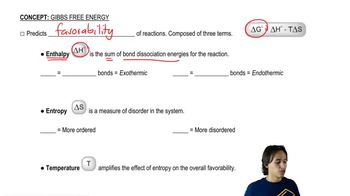
Breaking down the different terms of the Gibbs Free Energy equation.

Equilibrium Constant (K)

The equilibrium constant (K) quantifies the ratio of the concentrations of products to reactants at equilibrium for a reversible reaction. It is related to the Gibbs Free Energy change by the equation ∆G° = -RT ln(K), where R is the gas constant and T is the temperature in Kelvin. By calculating K from the given ∆G°, we can determine the ratio of equatorial to axial fluorocyclohexane, which helps in finding the percentage of equatorial molecules.
Recommended video:
Guided course
02:19
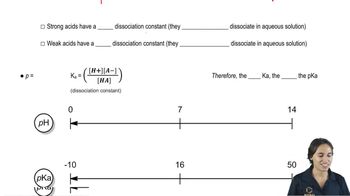
The relationship between equilibrium constant and pKa.

Percentage Calculation at Equilibrium

To find the percentage of molecules in a specific conformation at equilibrium, we use the equilibrium constant (K) derived from the Gibbs Free Energy. The formula K = [equatorial]/[axial] allows us to express the fraction of equatorial molecules as [equatorial] / ([equatorial] + [axial]). By converting this fraction into a percentage, we can determine how many of the fluorocyclohexane molecules are in the equatorial position at equilibrium.
Recommended video:
Guided course
03:23
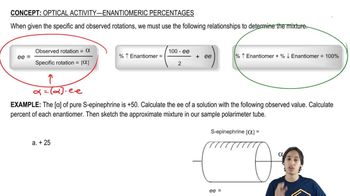
How to solve for the percentage of each enantiomer.