Ch. 5 - Alkenes: Structure, Nomenclature, and an Introduction to Reactivity • Thermodynamics and Kinetics
Bruice - Organic Chemistry 8th Edition
Bruice8th EditionOrganic ChemistryISBN: 9780135213711Not the one you use?Change textbook
Chapter 6, Problem 46b

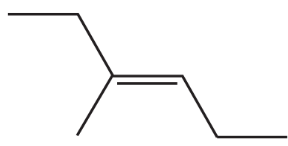
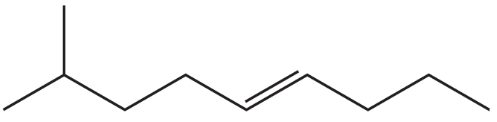
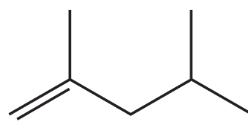
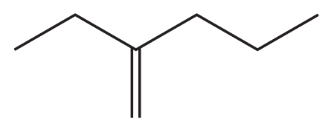
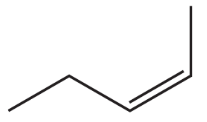
Of the compounds you named in Problem 45:
b. Which is the least stable?
a.
b.
c.
d.
e.
f.

Verified step by step guidance
1
Step 1: Analyze the stability of each compound based on structural features such as branching, conjugation, and the presence of electronegative atoms or functional groups. Stability is influenced by factors like hyperconjugation, resonance, and steric hindrance.
Step 2: Consider the degree of branching in the alkyl chains. Highly branched compounds tend to be more stable due to hyperconjugation and reduced steric strain.
Step 3: Evaluate the presence of double bonds or functional groups. Conjugated systems (alternating double and single bonds) are generally more stable due to resonance stabilization, while isolated double bonds may be less stable.
Step 4: Examine the presence of electronegative atoms or halogens (e.g., bromine). Electronegative atoms can stabilize the molecule through inductive effects, but they can also introduce steric hindrance depending on their position.
Step 5: Compare all compounds and identify the one with the least stabilizing features, such as minimal branching, lack of conjugation, or steric hindrance caused by bulky groups or functional groups in unfavorable positions.

Verified video answer for a similar problem:

This video solution was recommended by our tutors as helpful for the problem above.
Video duration:
2m
Was this helpful?

Key Concepts

Here are the essential concepts you must grasp in order to answer the question correctly.

Stability of Organic Compounds

The stability of organic compounds is influenced by factors such as bond strength, steric hindrance, and electronic effects. Compounds with lower energy configurations, such as those with fewer steric clashes or more favorable resonance structures, tend to be more stable. Understanding these factors is crucial for predicting which compound might be the least stable in a given set.
Recommended video:
Guided course
01:40
Defining meso compounds.

Resonance Structures

Resonance structures are different ways of drawing the same molecule that illustrate the delocalization of electrons. Compounds with significant resonance stabilization are generally more stable because the electron density is spread over multiple atoms, reducing localized charge and increasing overall stability. Identifying resonance contributors can help assess the stability of the compounds in question.
Recommended video:
Guided course
03:04
Drawing Resonance Structures

Steric Hindrance

Steric hindrance refers to the repulsion between bulky groups within a molecule that can affect its stability and reactivity. When large substituents are close together, they can create strain, making the compound less stable. Evaluating the steric effects in the compounds can provide insight into which one is likely to be the least stable.
Recommended video:
Guided course
02:53
Understanding steric effects.