Ch. 5 - Alkenes: Structure, Nomenclature, and an Introduction to Reactivity • Thermodynamics and Kinetics
Bruice - Organic Chemistry 8th Edition
Bruice8th EditionOrganic ChemistryISBN: 9780135213711Not the one you use?Change textbook
Chapter 6, Problem 14

Identify the nucleophile and the electrophile in the following acid–base reactions:
a. Chemical reaction showing AlCl3 and NH3 forming a complex, indicating nucleophile and electrophile roles.
b. Chemical equation illustrating an acid-base reaction with nucleophile and electrophile identified.

Verified step by step guidance
1
Step 1: Understand the concept of nucleophiles and electrophiles. A nucleophile is an electron-rich species that donates a pair of electrons, while an electrophile is an electron-deficient species that accepts a pair of electrons.
Step 2: Analyze reaction A. In the reaction BH₃ + NH₃ ⇌ H₃B⁻NH₃⁺, BH₃ is electron-deficient due to the incomplete octet of boron, making it the electrophile. NH₃ has a lone pair of electrons on nitrogen, making it the nucleophile.
Step 3: Analyze reaction B. In the reaction HCl + OH⁻ ⇌ Cl⁻ + H₂O, HCl acts as the electrophile because the hydrogen atom is electron-deficient and can accept a pair of electrons. OH⁻ is the nucleophile because it has a lone pair of electrons and a negative charge, making it electron-rich.
Step 4: Recognize the acid-base nature of these reactions. In reaction A, NH₃ acts as a Lewis base (electron donor), and BH₃ acts as a Lewis acid (electron acceptor). In reaction B, OH⁻ acts as a Bronsted-Lowry base (proton acceptor), and HCl acts as a Bronsted-Lowry acid (proton donor).
Step 5: Summarize the identification. For reaction A, NH₃ is the nucleophile and BH₃ is the electrophile. For reaction B, OH⁻ is the nucleophile and HCl is the electrophile.

Verified video answer for a similar problem:

This video solution was recommended by our tutors as helpful for the problem above.
Video duration:
5m
Was this helpful?

Key Concepts

Here are the essential concepts you must grasp in order to answer the question correctly.

Nucleophile

A nucleophile is a species that donates an electron pair to form a chemical bond in a reaction. Nucleophiles are typically negatively charged or neutral molecules with lone pairs of electrons. In the provided reactions, nucleophiles such as NH3 and OH- attack electrophiles, facilitating the formation of new bonds.
Recommended video:
Guided course
08:27
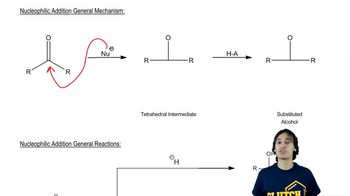
Nucleophilic Addition

Electrophile

An electrophile is a chemical species that accepts an electron pair from a nucleophile during a reaction. Electrophiles are often positively charged or electron-deficient molecules. In the given reactions, BH3 and HCl act as electrophiles, as they are capable of accepting electron pairs from nucleophiles like NH3 and OH-, respectively.
Recommended video:
Guided course
03:
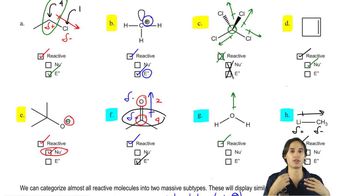
Nucleophile or Electrophile

Acid-Base Reactions

Acid-base reactions involve the transfer of protons (H+) between reactants, where acids donate protons and bases accept them. These reactions can also be viewed through the lens of nucleophiles and electrophiles, as bases often act as nucleophiles and acids as electrophiles. Understanding this relationship is crucial for identifying the roles of different species in the provided reactions.
Recommended video:
Guided course
02:49
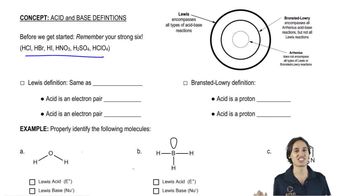
The Lewis definition of acids and bases.