Ch. 5 - Alkenes: Structure, Nomenclature, and an Introduction to Reactivity • Thermodynamics and Kinetics
Bruice - Organic Chemistry 8th Edition
Bruice8th EditionOrganic ChemistryISBN: 9780135213711Not the one you use?Change textbook
Chapter 6, Problem 11

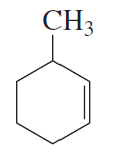
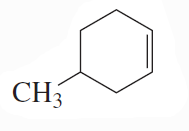
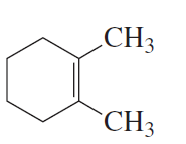
How many carbons are in the planar double-bond system in each of the following compounds?
a. Chemical structure of a hexagonal ring with a methyl group and a double bond, illustrating functional groups.
b. Chemical structure of a cyclohexane ring with a methyl group (CH3) attached, illustrating a planar double-bond system.
c. Chemical structure of a cyclohexene with two methyl groups attached, highlighting a planar double-bond system.

Verified step by step guidance
1
Step 1: Identify the planar double-bond system in each compound. A planar double-bond system typically involves conjugated double bonds or aromatic systems where the π-electrons are delocalized across the structure.
Step 2: For compound A, observe the conjugated double bonds in the five-membered ring. Count the carbons directly involved in the double bonds and any adjacent carbons that contribute to the conjugation.
Step 3: For compound B, examine the five-membered ring with double bonds. Similar to compound A, count the carbons involved in the double bonds and any adjacent carbons that are part of the conjugated system.
Step 4: For compound C, analyze the fused ring system. Identify the aromatic ring and the conjugated double bonds in the structure. Count the carbons that are part of the planar conjugated system.
Step 5: Summarize the number of carbons in the planar double-bond system for each compound based on the observations from Steps 2, 3, and 4.

Verified video answer for a similar problem:

This video solution was recommended by our tutors as helpful for the problem above.
Video duration:
4m
Was this helpful?

Key Concepts

Here are the essential concepts you must grasp in order to answer the question correctly.

Planar Double-Bond System

A planar double-bond system refers to a configuration in which atoms involved in double bonds lie in the same plane, allowing for effective overlap of p-orbitals. This arrangement is crucial for understanding the geometry and reactivity of organic compounds, as it influences molecular shape and the potential for stereoisomerism.
Recommended video:
Guided course
06:00
Single bonds, double bonds, and triple bonds.

Counting Carbons in Organic Structures

Counting carbons in organic structures involves identifying each carbon atom in a molecular diagram. In the context of double-bond systems, it is essential to recognize how many carbon atoms are directly involved in the double bonds, as this affects the compound's properties and classification.
Recommended video:
Guided course
07:07
Electron Counting

Cyclic Compounds

Cyclic compounds are organic molecules that contain a ring structure. The presence of double bonds within these rings can significantly affect their stability and reactivity. Understanding the nature of cyclic compounds is vital for analyzing their chemical behavior and determining the number of carbons in their double-bond systems.
Recommended video:
Guided course
01:40
Defining meso compounds.