Ch. 5 - Alkenes: Structure, Nomenclature, and an Introduction to Reactivity • Thermodynamics and Kinetics
Bruice - Organic Chemistry 8th Edition
Bruice8th EditionOrganic ChemistryISBN: 9780135213711Not the one you use?Change textbook
Chapter 6, Problem 58a-f

Given the reaction coordinate diagram for the reaction of A to form G, answer the following questions:
<IMAGE>
a. How many intermediates are formed in the reaction?
b. Which letters represent transition states?
c. What is the fastest step in the reaction?
d. Which is more stable: A or G?
e. Does A or E form faster from C?
f. Which is the more stable intermediate?

Verified step by step guidance
1
Step 1: Analyze the reaction coordinate diagram to identify intermediates. Intermediates are represented by valleys (local minima) between peaks. In this diagram, the valleys are labeled as C, E, and G, indicating three intermediates.
Step 2: Identify the transition states. Transition states are represented by peaks (local maxima) in the diagram. The peaks are labeled as B, D, F, and H, indicating four transition states.
Step 3: Determine the fastest step in the reaction. The fastest step corresponds to the transition state with the smallest energy barrier relative to the preceding intermediate. Compare the energy differences between intermediates and transition states to identify the smallest energy barrier.
Step 4: Compare the stability of A and G. Stability is inversely related to energy; the species with lower energy is more stable. Compare the energy levels of A and G on the diagram to determine which is more stable.
Step 5: Determine whether A or E forms faster from C. The rate of formation depends on the energy barrier to the transition state. Compare the energy barriers from C to B (leading to A) and from C to D (leading to E) to decide which forms faster. Also, identify the most stable intermediate by comparing the energy levels of C, E, and G.

Verified video answer for a similar problem:

This video solution was recommended by our tutors as helpful for the problem above.
Video duration:
6m
Was this helpful?

Key Concepts

Here are the essential concepts you must grasp in order to answer the question correctly.

Reaction Coordinate Diagram

A reaction coordinate diagram visually represents the energy changes during a chemical reaction. It plots the energy of the system against the progress of the reaction, showing the relative energies of reactants, products, intermediates, and transition states. This diagram helps in understanding the energy barriers that must be overcome for a reaction to proceed.
Recommended video:
Guided course
05:02
Coordination Complexes

Intermediates and Transition States

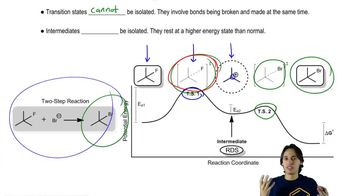
Intermediates are species that are formed during the reaction but are not the final products; they exist at local energy minima on the reaction coordinate diagram. Transition states, on the other hand, are high-energy states that occur at the peaks of the energy barriers, representing the point of maximum energy along the reaction pathway. Identifying these is crucial for understanding the reaction mechanism.
Recommended video:
Guided course
06:55
Intermediates vs. Transition States

Stability and Reaction Rates

The stability of a species in a reaction can be inferred from its position on the reaction coordinate diagram; lower energy states are more stable. Additionally, the rate of formation of intermediates or products is influenced by the energy barriers (transition states) they must overcome. The fastest step in a reaction is typically the one with the lowest activation energy, which can be identified by the smallest energy difference between the reactants and the transition state.
Recommended video:
5:07
Rates of Intramolecular Reactions Concept 2