Ch. 4 - Isomers: The Arrangement of Atoms in Space
Bruice - Organic Chemistry 8th Edition
Bruice8th EditionOrganic ChemistryISBN: 9780135213711Not the one you use?Change textbook
Chapter 5, Problem 67

Which of the following has an asymmetric center?
CHBr2Cl, BHFCl, CH3CHCl2, CHFBrCl, BeHCl

Verified step by step guidance
1
Step 1: Understand the concept of an asymmetric center. An asymmetric center (or chiral center) is a carbon atom that is bonded to four different groups or atoms. This lack of symmetry makes the molecule chiral, meaning it cannot be superimposed on its mirror image.
Step 2: Analyze the first compound, CHBr2Cl. The central carbon atom is bonded to two bromine atoms, one chlorine atom, and one hydrogen atom. Since there are two identical bromine atoms, the carbon is not bonded to four different groups, so it does not have an asymmetric center.
Step 3: Analyze the second compound, BHFCl. The central atom here is boron, which is bonded to hydrogen, fluorine, and chlorine. However, boron only forms three bonds and does not have a tetrahedral geometry. Therefore, it cannot have an asymmetric center.
Step 4: Analyze the third compound, CH3CHCl2. The first carbon atom (CH3) is bonded to three hydrogens and one carbon, so it is not asymmetric. The second carbon atom (CHCl2) is bonded to one hydrogen, one chlorine, and another chlorine. Since there are two identical chlorine atoms, this carbon is not bonded to four different groups and is not an asymmetric center.
Step 5: Analyze the fourth compound, CHFBrCl. The central carbon atom is bonded to four different groups: hydrogen, fluorine, bromine, and chlorine. This satisfies the condition for an asymmetric center. Finally, analyze the fifth compound, BeHCl. The central atom is beryllium, which forms only two bonds and does not have a tetrahedral geometry, so it cannot have an asymmetric center.

Verified video answer for a similar problem:

This video solution was recommended by our tutors as helpful for the problem above.
Video duration:
6m
Was this helpful?

Key Concepts

Here are the essential concepts you must grasp in order to answer the question correctly.

Asymmetric Center

An asymmetric center, or chiral center, is a carbon atom that is bonded to four different substituents, leading to non-superimposable mirror images known as enantiomers. The presence of an asymmetric center is crucial for determining the chirality of a molecule, which can significantly affect its chemical properties and biological activity.
Recommended video:
Guided course
03:38
How to add to asymmetrical double bonds.

Substituents

Substituents are atoms or groups of atoms that replace hydrogen atoms in a hydrocarbon chain. In the context of identifying asymmetric centers, it is essential to analyze the nature of the substituents attached to the carbon atom in question, as having four distinct substituents is what defines chirality.
Recommended video:
Guided course
01:47
Nucleophiles and Electrophiles can react in Substitution Reactions.

Chirality

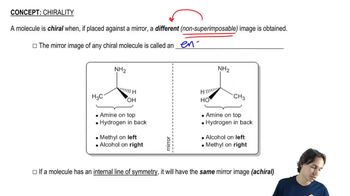
Chirality refers to the geometric property of a molecule that makes it non-superimposable on its mirror image. Molecules that possess chirality often exhibit different behaviors in biological systems, making the understanding of chirality important in fields such as pharmacology and biochemistry.
Recommended video:
Guided course
05:10
What is chirality?