Ch. 4 - Isomers: The Arrangement of Atoms in Space
Bruice - Organic Chemistry 8th Edition
Bruice8th EditionOrganic ChemistryISBN: 9780135213711Not the one you use?Change textbook
Chapter 5, Problem 12

Draw the Z isomer of an alkene that has a CH3 and an H on one sp2 carbon and isopropyl and butyl groups on the other sp2 carbon.

Verified step by step guidance
1
Identify the structure of the alkene: The problem specifies that the molecule is an alkene, meaning it contains a carbon-carbon double bond (C=C). Each sp² carbon in the double bond is bonded to two substituents.
Assign the substituents to each sp² carbon: One sp² carbon is bonded to a CH₃ (methyl) group and an H (hydrogen) atom. The other sp² carbon is bonded to an isopropyl group (CH(CH₃)₂) and a butyl group (CH₂CH₂CH₂CH₃).
Understand the Z isomer: The Z (zusammen) isomer of an alkene has the higher-priority substituents on the same side of the double bond. Use the Cahn-Ingold-Prelog priority rules to assign priorities to the substituents on each sp² carbon. Higher atomic number atoms or groups with greater mass take priority.
Assign priorities to the substituents: On the first sp² carbon, CH₃ has a higher priority than H. On the second sp² carbon, the butyl group has a higher priority than the isopropyl group because the butyl group has a longer carbon chain.
Draw the Z isomer: Place the higher-priority groups (CH₃ and butyl) on the same side of the double bond, while the lower-priority groups (H and isopropyl) are on the opposite side. Ensure the double bond is clearly shown, and the spatial arrangement reflects the Z configuration.

Verified video answer for a similar problem:

This video solution was recommended by our tutors as helpful for the problem above.
Video duration:
4m
Was this helpful?

Key Concepts

Here are the essential concepts you must grasp in order to answer the question correctly.

Z and E Isomerism

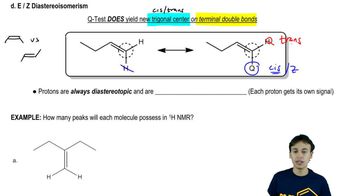
Z and E isomerism refers to the geometric isomerism in alkenes based on the arrangement of substituents around the double bond. In Z isomers, the highest priority substituents on each carbon of the double bond are on the same side, while in E isomers, they are on opposite sides. This distinction is crucial for understanding the spatial orientation of the groups attached to the double bond.
Recommended video:
Guided course
03:48
E/Z Diastereoisomerism

Priority Rules (Cahn-Ingold-Prelog)

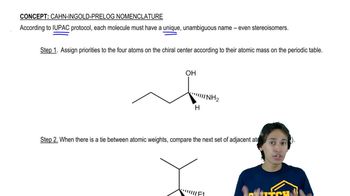
The Cahn-Ingold-Prelog priority rules are used to determine the priority of substituents attached to the double-bonded carbons in alkenes. The priority is assigned based on atomic number; the higher the atomic number, the higher the priority. If two substituents have the same atom, the next atoms in the chain are considered until a difference is found, which is essential for correctly identifying Z and E configurations.
Recommended video:
Guided course
01:48
Why stereoisomers need their own naming system.

Alkene Structure and Hybridization

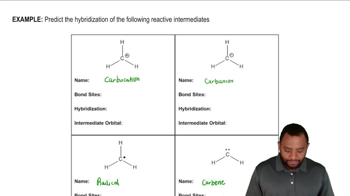
Alkenes are hydrocarbons that contain at least one carbon-carbon double bond (C=C), characterized by sp2 hybridization of the carbon atoms involved in the double bond. This hybridization leads to a trigonal planar geometry around the sp2 carbons, influencing the physical and chemical properties of the alkene, including its isomerism. Understanding the structure helps in visualizing the spatial arrangement of substituents.
Recommended video:
Guided course
04:58
Bond sites, hybridization, and intermediate orbitals