Ch. 4 - Isomers: The Arrangement of Atoms in Space
Bruice - Organic Chemistry 8th Edition
Bruice8th EditionOrganic ChemistryISBN: 9780135213711Not the one you use?Change textbook
Chapter 5, Problem 51g,h

Draw all the stereoisomers for each of the following:
g. 1,3-dichlorocyclohexane
h. 1,4-dichlorocyclohexane

Verified step by step guidance
1
Step 1: Understand the concept of stereoisomers. Stereoisomers are compounds with the same molecular formula and connectivity of atoms but differ in the spatial arrangement of atoms. For cyclohexane derivatives, consider both cis (same side) and trans (opposite side) configurations.
Step 2: Analyze the structure of 1,3-dichlorocyclohexane. The chlorine atoms are attached to the 1st and 3rd carbons of the cyclohexane ring. Consider the chair conformation of cyclohexane, where substituents can occupy axial (vertical) or equatorial (horizontal) positions.
Step 3: Draw the stereoisomers for 1,3-dichlorocyclohexane. For cis-1,3-dichlorocyclohexane, both chlorine atoms will be on the same side of the ring (either both axial or both equatorial). For trans-1,3-dichlorocyclohexane, one chlorine will be axial and the other equatorial, on opposite sides of the ring.
Step 4: Analyze the structure of 1,4-dichlorocyclohexane. The chlorine atoms are attached to the 1st and 4th carbons of the cyclohexane ring. Again, consider the chair conformation and the spatial arrangement of substituents.
Step 5: Draw the stereoisomers for 1,4-dichlorocyclohexane. For cis-1,4-dichlorocyclohexane, both chlorine atoms will be on the same side of the ring (either both axial or both equatorial). For trans-1,4-dichlorocyclohexane, one chlorine will be axial and the other equatorial, on opposite sides of the ring.

Verified video answer for a similar problem:

This video solution was recommended by our tutors as helpful for the problem above.
Video duration:
4m
Was this helpful?

Key Concepts

Here are the essential concepts you must grasp in order to answer the question correctly.

Stereoisomerism

Stereoisomerism refers to the phenomenon where compounds have the same molecular formula and connectivity of atoms but differ in the spatial arrangement of their atoms. This can lead to different physical and chemical properties. In organic chemistry, stereoisomers can be classified into two main types: geometric isomers (cis/trans) and optical isomers (enantiomers). Understanding stereoisomerism is crucial for drawing and identifying the different forms of compounds like 1,3-dichlorocyclohexane and 1,4-dichlorocyclohexane.
Recommended video:
Guided course
01:58
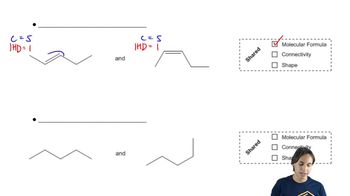
Determining when molecules are stereoisomers.

Cyclohexane Conformation

Cyclohexane can adopt various conformations, primarily the chair and boat forms, which significantly influence the stability and reactivity of substituents on the ring. The chair conformation is the most stable due to minimized steric strain, while substituents can occupy axial or equatorial positions. Recognizing these conformations is essential for accurately determining the stereochemistry of substituted cyclohexanes, such as the dichlorocyclohexanes in the question.
Recommended video:
Guided course
03:29
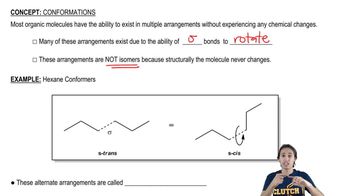
Understanding what a conformer is.

Chirality and Optical Activity

Chirality occurs when a molecule cannot be superimposed on its mirror image, often due to the presence of a chiral center, typically a carbon atom bonded to four different substituents. Molecules that are chiral exhibit optical activity, meaning they can rotate plane-polarized light. In the context of 1,3-dichlorocyclohexane and 1,4-dichlorocyclohexane, identifying chiral centers is vital for determining the number of stereoisomers and their configurations.
Recommended video:
Guided course
08:17
Mutorotation and Optical Activity