
Textbook Question
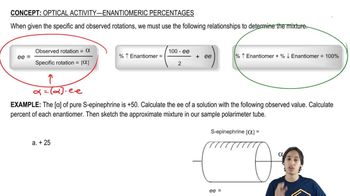
The specific rotation of (R)-(+)-glyceraldehyde is +8.7. If the observed specific rotation of a mixture of (R)-glyceraldehyde and (S)-glyceraldehyde is +1.4, what percent of glyceraldehyde is present as the R enantiomer?
4
views
 Verified step by step guidance
 01:58
01:58
 03:23
03:23 03:44
03:44The specific rotation of (R)-(+)-glyceraldehyde is +8.7. If the observed specific rotation of a mixture of (R)-glyceraldehyde and (S)-glyceraldehyde is +1.4, what percent of glyceraldehyde is present as the R enantiomer?
A solution of an unknown compound (3.0 g of the compound in 200 mL of solution), when placed in a polarimeter tube 2.0 dm long, was found to rotate the plane of polarized light 18° in a counterclockwise direction. What is the specific rotation of the compound?
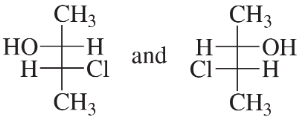
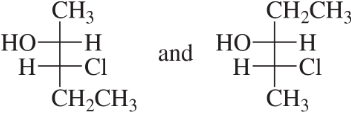
Indicate whether each of the following structures is (R)-2-chlorobutane or (S)-2-chlorobutane:
c.
d.
Citrate synthase, one of the enzymes in the series of enzyme-catalyzed reactions known as the citric acid cycle, catalyzes the synthesis of citric acid from oxaloacetic acid and acetyl-CoA. If the synthesis is carried out with acetyl-CoA that contains radioactive carbon (14C) in the indicated position, the isomer shown here is obtained.
b. If the acetyl-CoA used in the synthesis contains 12C instead of 14C, will the product of the reaction be chiral or achiral?
Indicate whether each of the following structures is (R)-2-chlorobutane or (S)-2-chlorobutane:
a.
b.
Citrate synthase, one of the enzymes in the series of enzyme-catalyzed reactions known as the citric acid cycle, catalyzes the synthesis of citric acid from oxaloacetic acid and acetyl-CoA. If the synthesis is carried out with acetyl-CoA that contains radioactive carbon (14C) in the indicated position, the isomer shown here is obtained.
a. Which stereoisomer of citric acid is synthesized: R or S?