Ch. 4 - Isomers: The Arrangement of Atoms in Space
Bruice - Organic Chemistry 8th Edition
Bruice8th EditionOrganic ChemistryISBN: 9780135213711Not the one you use?Change textbook
Chapter 5, Problem 96

A sample of (S)-(+)-lactic acid was found to have an enantiomeric excess of 72%. How much R isomer is present in the sample?

Verified step by step guidance
1
Understand the concept of enantiomeric excess (ee): Enantiomeric excess is a measure of the purity of one enantiomer in a mixture. It is defined as the absolute difference between the percentage of the two enantiomers, expressed as: ee=(%S-%R).
Recognize that the enantiomeric excess (ee) is given as 72%. This means that the excess of the (S)-isomer over the (R)-isomer is 72%.
Recall that the total percentage of both enantiomers in the sample must equal 100%. Let the percentage of the (R)-isomer be x, and the percentage of the (S)-isomer be (100-x).
Set up the equation for enantiomeric excess: 72=(100-x)-x. This equation represents the difference between the percentage of the (S)-isomer and the (R)-isomer.
Solve the equation for x to determine the percentage of the (R)-isomer in the sample. This will give you the amount of the (R)-isomer present.

Verified video answer for a similar problem:

This video solution was recommended by our tutors as helpful for the problem above.
Video duration:
1m
Was this helpful?

Key Concepts

Here are the essential concepts you must grasp in order to answer the question correctly.

Enantiomeric Excess

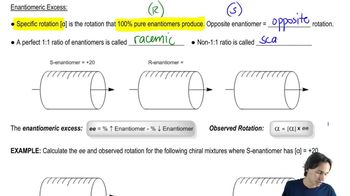
Enantiomeric excess (ee) is a measure of the purity of an enantiomer in a mixture of chiral compounds. It is calculated as the difference in the mole fractions of the two enantiomers, expressed as a percentage. An enantiomeric excess of 72% indicates that one enantiomer is present in greater quantity than the other, which is crucial for determining the amounts of each isomer in the sample.
Recommended video:
Guided course
04:21
How to calculate enantiomeric excess.

Chirality and Enantiomers

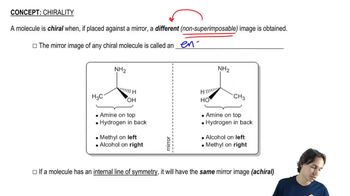
Chirality refers to the geometric property of a molecule that makes it non-superimposable on its mirror image, leading to the existence of two enantiomers. Enantiomers are pairs of chiral molecules that are mirror images of each other, often exhibiting different biological activities. Understanding chirality is essential for analyzing compounds like lactic acid, which has both (S)- and (R)- forms.
Recommended video:
Guided course
05:10
What is chirality?

Calculating Isomer Amounts

To calculate the amounts of each isomer in a sample with a known enantiomeric excess, one can use the formula: %ee = [(R) - (S)] / [(R) + (S)] × 100%. Given the enantiomeric excess, one can derive the ratio of the two isomers and subsequently determine the absolute amounts of each isomer present in the sample.
Recommended video:
Guided course
01:10
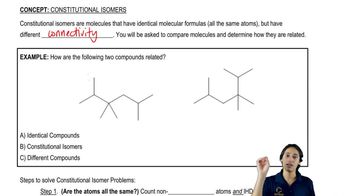
What is a constitutional isomer?