Ch. 4 - Isomers: The Arrangement of Atoms in Space
Bruice - Organic Chemistry 8th Edition
Bruice8th EditionOrganic ChemistryISBN: 9780135213711Not the one you use?Change textbook
Chapter 5, Problem 91

A compound has a specific rotation of -39.0. A solution of the compound (0.187 g/100 mL) has an observed rotation of -6.52° when placed in a polarimeter tube 10 cm long. What is the percent of each enantiomer in the solution?

Verified step by step guidance
1
Understand the problem: The specific rotation ([α]) of a compound is given as -39.0. The observed rotation (α_obs) is -6.52°, the concentration (c) is 0.187 g/100 mL (convert to g/mL), and the path length (l) is 10 cm (convert to dm). The goal is to determine the percent composition of each enantiomer in the solution.
Use the formula for specific rotation: [α] = α_obs / (c × l). Rearrange the formula to solve for the observed specific rotation of the solution: α_obs = [α] × (c × l). Substitute the given values to calculate the observed specific rotation.
Determine the enantiomeric excess (ee) using the relationship between the observed specific rotation and the specific rotation of the pure enantiomer: ee = (observed specific rotation / specific rotation of pure enantiomer) × 100. Substitute the calculated observed specific rotation and the given specific rotation of the pure enantiomer (-39.0) to find the enantiomeric excess.
Relate the enantiomeric excess (ee) to the percent composition of each enantiomer. The enantiomeric excess represents the difference in percentage between the two enantiomers. Use the formula: % major enantiomer = (100 + ee) / 2 and % minor enantiomer = (100 - ee) / 2.
Substitute the calculated enantiomeric excess into the formulas for the percent composition of the major and minor enantiomers to determine their respective percentages.

Verified video answer for a similar problem:

This video solution was recommended by our tutors as helpful for the problem above.
Video duration:
7m
Was this helpful?

Key Concepts

Here are the essential concepts you must grasp in order to answer the question correctly.

Specific Rotation

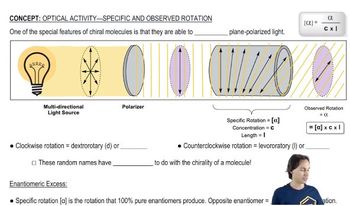
Specific rotation is a property of chiral compounds that quantifies their ability to rotate plane-polarized light. It is defined as the observed rotation of light (in degrees) divided by the concentration of the solution (in g/mL) and the path length of the polarimeter tube (in dm). This value is unique to each chiral compound and is crucial for determining the enantiomeric composition of a mixture.
Recommended video:
Guided course
05:43
Specific rotation vs. observed rotation.

Enantiomers and Optical Purity

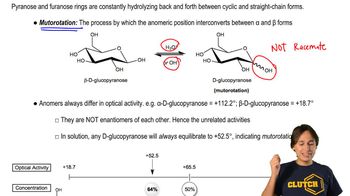
Enantiomers are pairs of molecules that are non-superimposable mirror images of each other, often exhibiting different optical activities. The optical purity of a mixture can be calculated using the specific rotation of the mixture compared to that of the pure enantiomer. This concept is essential for determining the percentage of each enantiomer in a solution based on their contributions to the observed rotation.
Recommended video:
Guided course
08:17
Mutorotation and Optical Activity

Calculation of Enantiomeric Excess

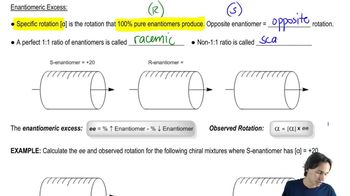
Enantiomeric excess (ee) is a measure of the purity of an enantiomer in a mixture, expressed as the difference in the mole fraction of the two enantiomers. It can be calculated using the formula ee = (|α| - |α'|) / (|α| + |α'|) × 100%, where α is the specific rotation of the mixture and α' is the specific rotation of the pure enantiomer. This concept is vital for quantifying the relative amounts of each enantiomer in the solution.
Recommended video:
Guided course
04:21
How to calculate enantiomeric excess.