Ch. 3 - An Introduction to Organic Compounds:Nomenclature, Physical Properties, and Structure
Bruice - Organic Chemistry 8th Edition
Bruice8th EditionOrganic ChemistryISBN: 9780135213711Not the one you use?Change textbook
Chapter 4, Problem 6

Which of the following statements can be used to prove that carbon is tetrahedral?
a. CH3Br does not have constitutional isomers.
b. CBr4 does not have a dipole moment.
c. CH2Br2 does not have constitutional isomers.

Verified step by step guidance
1
Step 1: Understand the concept of tetrahedral geometry. Carbon forms four single bonds in a tetrahedral arrangement due to sp3 hybridization. This geometry minimizes electron repulsion and is a fundamental property of carbon in organic molecules.
Step 2: Analyze statement (a): CH3Br does not have constitutional isomers. Constitutional isomers differ in the connectivity of atoms. Since CH3Br has a single carbon atom bonded to three hydrogens and one bromine, there is no alternative connectivity possible, supporting the tetrahedral nature of carbon.
Step 3: Analyze statement (b): CBr4 does not have a dipole moment. In a tetrahedral molecule like CBr4, the symmetry cancels out any dipole moments from the individual C-Br bonds, resulting in a nonpolar molecule. This is consistent with the tetrahedral geometry of carbon.
Step 4: Analyze statement (c): CH2Br2 does not have constitutional isomers. CH2Br2 has one carbon atom bonded to two hydrogens and two bromines. The tetrahedral arrangement ensures that there is no alternative connectivity possible, supporting the tetrahedral nature of carbon.
Step 5: Conclude that all three statements (a, b, and c) provide evidence for the tetrahedral geometry of carbon. Each statement highlights a property or behavior that is consistent with the sp3 hybridization and tetrahedral arrangement of carbon atoms in organic molecules.

Verified video answer for a similar problem:

This video solution was recommended by our tutors as helpful for the problem above.
Video duration:
7m
Was this helpful?

Key Concepts

Here are the essential concepts you must grasp in order to answer the question correctly.

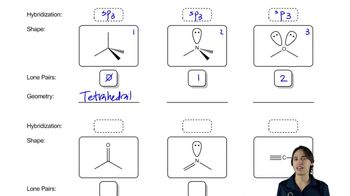
Tetrahedral Geometry

Tetrahedral geometry refers to the three-dimensional arrangement of atoms around a central atom, where four substituents are positioned at the corners of a tetrahedron. In organic chemistry, carbon typically exhibits this geometry when it forms four single bonds, as seen in methane (CH4). This spatial arrangement minimizes electron pair repulsion, leading to a stable molecular structure.
Recommended video:
Guided course
07:44
Molecular Geometry Explained.

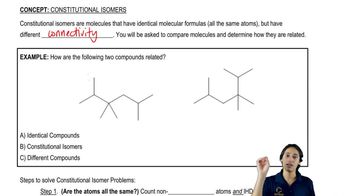
Constitutional Isomers

Constitutional isomers are compounds that have the same molecular formula but differ in the connectivity of their atoms. This concept is crucial in organic chemistry as it helps in understanding the diversity of organic compounds. The presence or absence of constitutional isomers can indicate the degree of symmetry and the types of bonds present in a molecule, which can relate to the geometry of carbon.
Recommended video:
Guided course
01:10
What is a constitutional isomer?

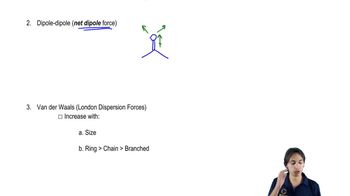
Dipole Moment

A dipole moment is a measure of the separation of positive and negative charges in a molecule, which results from differences in electronegativity between bonded atoms. In tetrahedral molecules like carbon compounds, the symmetry of the structure can lead to a cancellation of dipole moments, resulting in a nonpolar molecule. Understanding dipole moments is essential for predicting molecular behavior and interactions.
Recommended video:
Guided course
01:46
How dipole-dipole forces work.