Ch. 3 - An Introduction to Organic Compounds:Nomenclature, Physical Properties, and Structure
Bruice - Organic Chemistry 8th Edition
Bruice8th EditionOrganic ChemistryISBN: 9780135213711Not the one you use?Change textbook
Chapter 4, Problem 63g

Which has
g. the higher boiling point: 1-bromopentane or 1-chloropentane?

Verified step by step guidance
1
Step 1: Understand the factors that influence boiling points. Boiling points are affected by intermolecular forces such as hydrogen bonding, dipole-dipole interactions, and London dispersion forces. In this case, we are comparing two alkyl halides, 1-bromopentane and 1-chloropentane, which primarily exhibit dipole-dipole interactions and London dispersion forces.
Step 2: Compare the halogen atoms (bromine and chlorine) in terms of their size and polarizability. Bromine is larger and more polarizable than chlorine, meaning it can induce stronger London dispersion forces. This contributes to a higher boiling point for compounds containing bromine.
Step 3: Consider the molecular structure of both compounds. Both 1-bromopentane and 1-chloropentane have the same pentane backbone, so their molecular size and shape are similar. The difference in boiling point will primarily arise from the halogen atom attached to the molecule.
Step 4: Evaluate the dipole-dipole interactions. Bromine is less electronegative than chlorine, so the dipole moment of 1-bromopentane may be slightly weaker than that of 1-chloropentane. However, the stronger London dispersion forces due to bromine's larger size and polarizability outweigh this factor.
Step 5: Conclude that 1-bromopentane has the higher boiling point compared to 1-chloropentane, primarily due to the stronger London dispersion forces associated with the larger and more polarizable bromine atom.

Verified video answer for a similar problem:

This video solution was recommended by our tutors as helpful for the problem above.
Video duration:
4m
Was this helpful?

Key Concepts

Here are the essential concepts you must grasp in order to answer the question correctly.

Boiling Point and Intermolecular Forces

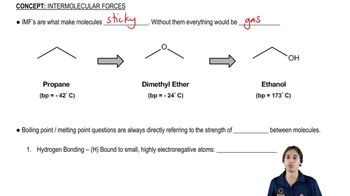
The boiling point of a substance is influenced by the strength of its intermolecular forces. Stronger forces, such as hydrogen bonding or dipole-dipole interactions, typically result in higher boiling points. In organic compounds, factors like molecular weight and polarity also play significant roles in determining boiling points.
Recommended video:
Guided course
03:08
How IMFs are related to melting and boiling points.

Halogen Substitution Effects

In organic chemistry, the presence of halogens (like bromine and chlorine) affects the physical properties of molecules. Bromine is larger and more polarizable than chlorine, which can lead to stronger London dispersion forces in brominated compounds. This difference in size and polarizability can influence the boiling points of halogenated alkanes.
Recommended video:
2:02
Directing Effects in Substituted Pyrroles, Furans, and Thiophenes Concept 1

Comparative Analysis of Similar Compounds

When comparing compounds like 1-bromopentane and 1-chloropentane, it is essential to analyze their structural similarities and differences. Both compounds have the same carbon chain length, but the type of halogen affects their boiling points. Understanding how these structural differences impact physical properties is crucial for making accurate comparisons.
Recommended video:
Guided course
01:40
Defining meso compounds.