Ch. 3 - An Introduction to Organic Compounds:Nomenclature, Physical Properties, and Structure
Bruice - Organic Chemistry 8th Edition
Bruice8th EditionOrganic ChemistryISBN: 9780135213711Not the one you use?Change textbook
Chapter 4, Problem 82

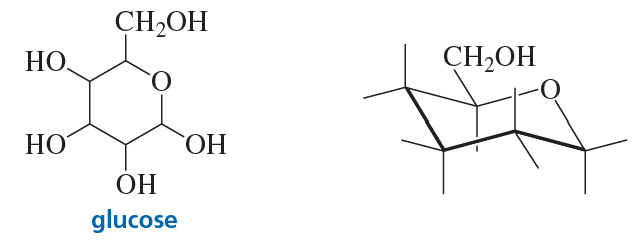
The most stable form of glucose (blood sugar) is a six-membered ring in a chair conformation with its five substituents all in equatorial positions. Draw the most stable conformer of glucose by putting the OH groups and hydrogens on the appropriate bonds in the structure on the right.
Structural representation of glucose showing its six-membered ring and chair conformation with equatorial substituents.

Verified step by step guidance
1
Analyze the glucose derivative structure on the left. It is a six-membered ring (pyranose form) with hydroxyl (-OH) groups and a methoxy (-CH2OCH3) substituent attached to the ring.
Understand that the most stable chair conformation of glucose places bulky substituents, such as hydroxyl groups, in equatorial positions to minimize steric hindrance.
Examine the chair conformation template on the right. Identify the axial and equatorial positions for each carbon atom in the ring.
Place the hydroxyl (-OH) groups in equatorial positions on the chair conformation. For example, the -OH groups on carbons 2, 3, 4, and 6 should be positioned equatorially.
Position the methoxy (-CH2OCH3) group on carbon 1 in the equatorial position as well, ensuring all substituents are arranged to minimize steric strain and maximize stability.

Verified video answer for a similar problem:

This video solution was recommended by our tutors as helpful for the problem above.
Video duration:
4m
Was this helpful?

Key Concepts

Here are the essential concepts you must grasp in order to answer the question correctly.

Chair Conformation

The chair conformation is a three-dimensional representation of cyclohexane and its derivatives, where the carbon atoms are arranged in a staggered manner to minimize steric strain. In this conformation, substituents can occupy equatorial or axial positions, with equatorial positions generally being more stable due to reduced steric hindrance. Understanding this conformation is crucial for predicting the stability of cyclic sugars like glucose.
Recommended video:
Guided course
03:29
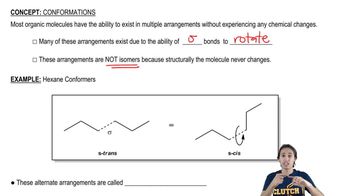
Understanding what a conformer is.

Equatorial vs. Axial Substituents

In a chair conformation, substituents can be positioned either equatorially or axially. Equatorial substituents extend outward from the ring, minimizing steric interactions with other groups, while axial substituents point up or down, potentially causing steric clashes. For glucose, placing hydroxyl (OH) groups in equatorial positions enhances stability, making it the preferred arrangement in its most stable form.
Recommended video:
Guided course
04:02
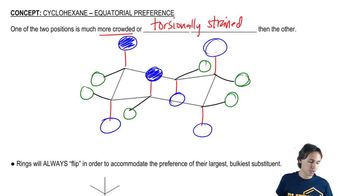
Equatorial Preference

Glucose Structure and Isomerism

Glucose is a six-carbon aldose sugar that can exist in various forms, including linear and cyclic structures. The cyclic form predominantly exists as a pyranose (six-membered ring) and can have different stereoisomers based on the orientation of its hydroxyl groups. Recognizing the specific stereochemistry of glucose is essential for accurately drawing its most stable conformer and understanding its biological functions.
Recommended video:
Guided course
06:47
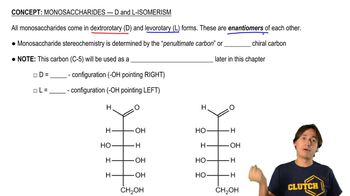
Monosaccharides - D and L Isomerism