Textbook Question
Explain why
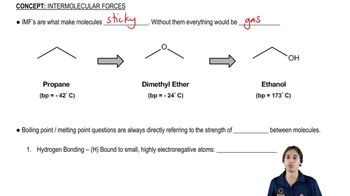
a. H2O (100 °C) has a higher boiling point than CH3OH 165 °C2.
b. H2O (100 °C) has a higher boiling point than NH3 (-33 °C).
5
views

 Bruice 8th EditionCh. 3 - An Introduction to Organic Compounds:Nomenclature, Physical Properties, and StructureProblem 35
 Verified step by step guidance
 03:08
03:08
 00:48
00:48 2:04
2:04Explain why
a. H2O (100 °C) has a higher boiling point than CH3OH 165 °C2.
b. H2O (100 °C) has a higher boiling point than NH3 (-33 °C).
The effectiveness of a barbiturate as a sedative is related to its ability to penetrate the nonpolar membrane of a cell. Which of the following barbiturates would you expect to be the more effective sedative?
Which of the preceding compounds forms hydrogen bonds with a solvent such as ethanol?
1. CH3CH2OCH2CH2OH
2. CH3CH2N(CH3)2
3. CH3CH2CH2CH2Br
Draw all the staggered and eclipsed conformers that result from rotation about the C-2-C-3 bond of pentane.
In which solvent would cyclohexane have the lowest solubility: 1-pentanol, diethyl ether, ethanol, or hexane?
Explain why
c. H2O (100 °C) has a higher boiling point than HF 120 °C2.
d. HF 120 °C2 has a higher boiling point than NH3 (-33 °C).