Ch. 3 - An Introduction to Organic Compounds:Nomenclature, Physical Properties, and Structure
Bruice - Organic Chemistry 8th Edition
Bruice8th EditionOrganic ChemistryISBN: 9780135213711Not the one you use?Change textbook
Chapter 4, Problem 16

How many hydrogens are attached to each of the indicated carbons in morphine?
Skeletal structure of morphine with arrows indicating hydrogen atoms on carbons.

Verified step by step guidance
1
Step 1: Analyze the structure of morphine provided in the image. Identify the carbons indicated by the blue arrows. These carbons are part of different functional groups and structural environments, which will determine the number of hydrogens attached to them.
Step 2: For each indicated carbon, determine its hybridization (sp3, sp2, or sp) and bonding environment. The hybridization affects the number of hydrogens attached. For example, sp3 carbons typically have up to 4 bonds, sp2 carbons have 3 bonds, and sp carbons have 2 bonds.
Step 3: Examine the connectivity of each indicated carbon. Count the number of bonds to other atoms (such as carbon, oxygen, or nitrogen) and subtract this from the total number of bonds the carbon can form based on its hybridization. The remaining bonds will be to hydrogen atoms.
Step 4: Consider any double bonds, aromatic rings, or functional groups (such as ethers, hydroxyl groups, or amines) that may influence the bonding environment of the indicated carbons. For example, carbons in aromatic rings typically have no hydrogens if they are part of a double bond.
Step 5: Assign the number of hydrogens to each indicated carbon based on the analysis above. Ensure that the total number of bonds for each carbon does not exceed its bonding capacity based on its hybridization.

Verified video answer for a similar problem:

This video solution was recommended by our tutors as helpful for the problem above.
Video duration:
4m
Was this helpful?

Key Concepts

Here are the essential concepts you must grasp in order to answer the question correctly.

Valency and Hydrogen Atoms

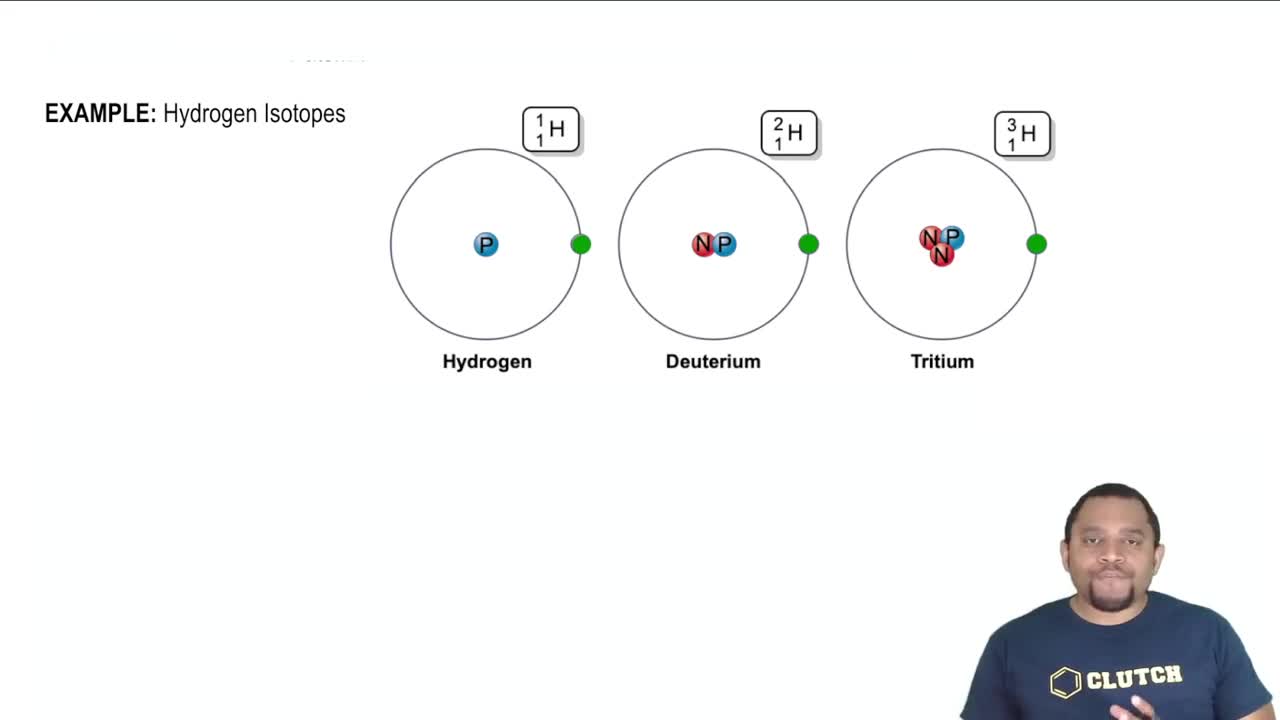
Valency refers to the ability of an atom to bond with other atoms, typically determined by the number of electrons in its outer shell. In organic chemistry, carbon typically forms four bonds, which can include bonds with hydrogen atoms. Understanding how many hydrogen atoms are attached to each carbon in a molecule like morphine requires knowledge of carbon's tetravalency and how it interacts with other atoms in the structure.
Recommended video:
Guided course
03:06
Understanding the hydrogen isotopes.

Skeletal Structures

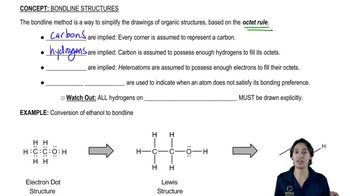
Skeletal structures are simplified representations of organic molecules that show the arrangement of atoms and bonds without depicting all hydrogen atoms explicitly. In these diagrams, carbon atoms are implied at the junctions and ends of lines, while hydrogen atoms are often omitted for clarity. Recognizing how to interpret skeletal structures is essential for determining the number of hydrogen atoms attached to specific carbons in a compound like morphine.
Recommended video:
Guided course
04:03
How bondline is different from Lewis Structures.

Functional Groups

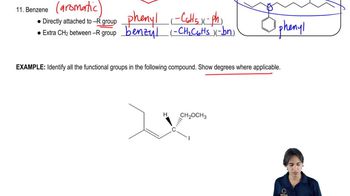
Functional groups are specific groups of atoms within molecules that are responsible for the characteristic chemical reactions of those molecules. In morphine, various functional groups, such as hydroxyl (-OH) and amine (-NH), influence the molecule's properties and reactivity. Identifying these groups helps in understanding how they affect the bonding and hydrogen attachment to the carbon skeleton.
Recommended video:
Guided course
02:36
Identifying Functional Groups