
Ch. 3 - An Introduction to Organic Compounds:Nomenclature, Physical Properties, and Structure
Bruice - Organic Chemistry 8th Edition
Bruice8th EditionOrganic ChemistryISBN: 9780135213711Not the one you use?Change textbook
Chapter 4, Problem 71c,d

For rotation about the C-3---C-4 bond of 2-methylhexane, do the following:
c. About which other carbon–carbon bonds may rotation occur?
d. How many of the carbon–carbon bonds in the compound have staggered conformers that are all equally stable?

Verified step by step guidance
1
Step 1: Analyze the structure of 2,5-dimethylhexane. The molecule consists of a hexane backbone with methyl groups attached to carbons 2 and 5. Each carbon-carbon single bond in the molecule allows for free rotation unless steric hindrance or other factors restrict it.
Step 2: For part (c), identify all carbon-carbon single bonds in the molecule. Rotation can occur about any single bond, including C-1-C-2, C-2-C-3, C-3-C-4, C-4-C-5, and C-5-C-6. These bonds are not part of a ring or constrained by double bonds, so they are free to rotate.
Step 3: For part (d), consider the staggered conformers of each bond. Staggered conformers are generally more stable due to minimized torsional strain. However, the presence of substituents like methyl groups can create steric hindrance, leading to differences in stability among staggered conformers.
Step 4: Evaluate the symmetry and substituent effects. For the C-3-C-4 bond, the substituents on either side are hydrogen atoms and methyl groups, which may lead to unequal stability among staggered conformers. Similarly, for other bonds like C-2-C-3 and C-4-C-5, the presence of methyl groups affects the stability of staggered conformers.
Step 5: Conclude that the carbon-carbon bonds with staggered conformers that are all equally stable are those where substituents on either side of the bond are identical or symmetrical. In this molecule, the C-1-C-2 and C-5-C-6 bonds have staggered conformers that are all equally stable because they are flanked by hydrogens and methyl groups symmetrically.

Verified video answer for a similar problem:

This video solution was recommended by our tutors as helpful for the problem above.
Video duration:
4m
Was this helpful?

Key Concepts

Here are the essential concepts you must grasp in order to answer the question correctly.

Conformational Isomerism

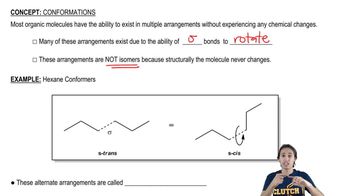
Conformational isomerism refers to the different spatial arrangements of atoms in a molecule that can be interconverted by rotation around single bonds. In alkanes like 2,5-dimethylhexane, this leads to staggered and eclipsed conformations, which differ in energy and stability. Understanding these conformations is crucial for analyzing the stability and reactivity of the molecule.
Recommended video:
Guided course
03:29
Understanding what a conformer is.

Staggered vs. Eclipsed Conformations

In the context of conformational analysis, staggered conformations occur when atoms or groups are positioned as far apart as possible, minimizing steric hindrance and torsional strain. Conversely, eclipsed conformations have atoms aligned with each other, leading to increased repulsion and higher energy. Identifying which conformations are staggered and their stability is essential for answering questions about rotation around specific bonds.
Recommended video:
Guided course
03:29
Understanding what a conformer is.

Rotational Freedom in Alkanes

Alkanes exhibit rotational freedom around their carbon-carbon single bonds, allowing for various conformations. In 2,5-dimethylhexane, rotation can occur around multiple bonds, not just the C-3-C-4 bond mentioned in the question. Recognizing all the bonds that allow rotation is important for understanding the overall conformational landscape of the molecule and determining the number of stable staggered conformers.
Recommended video:
Guided course
02:47
Functionalizing Alkanes