Ch. 3 - An Introduction to Organic Compounds:Nomenclature, Physical Properties, and Structure
Bruice - Organic Chemistry 8th Edition
Bruice8th EditionOrganic ChemistryISBN: 9780135213711Not the one you use?Change textbook
Chapter 4, Problem 51a,b

For each of the following disubstituted cyclohexanes, indicate whether the substituents in the two chair conformers are both equatorial in one chair conformer and both axial in the other or one equatorial and one axial in each of the chair conformers:
a. cis-1,2-
b. trans-1,2-

Verified step by step guidance
1
Step 1: Understand the problem. The question asks us to analyze the chair conformations of disubstituted cyclohexanes (cis-1,2- and trans-1,2-) and determine the positions of the substituents (axial or equatorial) in each conformer. Recall that cyclohexane can adopt two chair conformations, and substituents can occupy either axial (perpendicular to the ring plane) or equatorial (roughly parallel to the ring plane) positions.
Step 2: Analyze the cis-1,2-disubstituted cyclohexane. In the cis configuration, the two substituents are on the same side of the ring (both up or both down). Draw the two possible chair conformations for cis-1,2-disubstituted cyclohexane. In one conformer, both substituents will be equatorial, and in the other conformer, both substituents will be axial.
Step 3: Analyze the trans-1,2-disubstituted cyclohexane. In the trans configuration, the two substituents are on opposite sides of the ring (one up and one down). Draw the two possible chair conformations for trans-1,2-disubstituted cyclohexane. In each conformer, one substituent will be equatorial, and the other will be axial.
Step 4: Use the chair flip concept to confirm your analysis. A chair flip interconverts the axial and equatorial positions of all substituents. For cis-1,2-, flipping the chair will switch both substituents from equatorial to axial or vice versa. For trans-1,2-, flipping the chair will switch one substituent from equatorial to axial and the other from axial to equatorial.
Step 5: Summarize the results. For cis-1,2-disubstituted cyclohexane, the substituents are both equatorial in one conformer and both axial in the other. For trans-1,2-disubstituted cyclohexane, one substituent is equatorial and the other is axial in each conformer. This analysis is based on the spatial arrangement of substituents and the geometry of the cyclohexane chair conformations.

Verified video answer for a similar problem:

This video solution was recommended by our tutors as helpful for the problem above.
Video duration:
6m
Was this helpful?

Key Concepts

Here are the essential concepts you must grasp in order to answer the question correctly.

Chair Conformation

Chair conformation is the most stable form of cyclohexane, allowing for minimized steric strain. In this conformation, carbon atoms adopt a staggered arrangement, which positions substituents in either equatorial (outward) or axial (upward/downward) orientations. Understanding chair conformations is crucial for analyzing the spatial arrangement of substituents in disubstituted cyclohexanes.
Recommended video:
Guided course
03:29
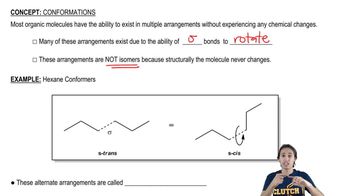
Understanding what a conformer is.

Equatorial vs. Axial Substituents

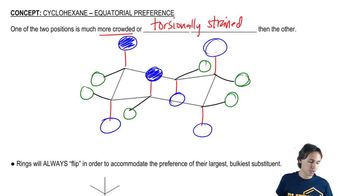
In cyclohexane chair conformations, substituents can be positioned either equatorially or axially. Equatorial substituents extend outward from the ring, minimizing steric hindrance, while axial substituents point parallel to the ring's axis, which can lead to increased steric interactions. The stability of a cyclohexane derivative often depends on the arrangement of these substituents.
Recommended video:
Guided course
04:02
Equatorial Preference

Cis and Trans Isomerism

Cis and trans isomerism refers to the relative positioning of substituents on a cyclohexane ring. In cis isomers, substituents are on the same side of the ring, while in trans isomers, they are on opposite sides. This distinction affects the conformational analysis, as it influences whether substituents can both be equatorial or if one must be axial in the chair conformations.
Recommended video:
Guided course
00:44
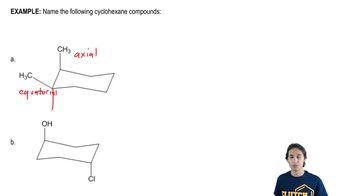
Is the following cyclohexane cis or trans?