Ch. 3 - An Introduction to Organic Compounds:Nomenclature, Physical Properties, and Structure
Bruice - Organic Chemistry 8th Edition
Bruice8th EditionOrganic ChemistryISBN: 9780135213711Not the one you use?Change textbook
Chapter 4, Problem 7e,f

Draw the structure for each of the following:
e. tert-butylamine
f. n-octyl bromide

Verified step by step guidance
1
Step 1: Understand the naming conventions for organic compounds. 'tert-butylamine' refers to a compound where a tert-butyl group (a central carbon atom bonded to three methyl groups) is attached to an amine group (-NH₂). 'n-octyl bromide' refers to a straight-chain alkyl group with eight carbons (octyl) attached to a bromine atom.
Step 2: For tert-butylamine, start by drawing the tert-butyl group. This consists of a central carbon atom bonded to three methyl groups (CH₃). Use MathML: C4H9.
Step 3: Attach the amine group (-NH₂) to the central carbon atom of the tert-butyl group. This completes the structure of tert-butylamine.
Step 4: For n-octyl bromide, draw a straight chain of eight carbon atoms. Use MathML: C8H17.
Step 5: Attach a bromine atom (Br) to the terminal carbon atom of the straight chain. This completes the structure of n-octyl bromide.

Verified video answer for a similar problem:

This video solution was recommended by our tutors as helpful for the problem above.
Video duration:
1m
Was this helpful?

Key Concepts

Here are the essential concepts you must grasp in order to answer the question correctly.

Functional Groups

Functional groups are specific groups of atoms within molecules that are responsible for the characteristic chemical reactions of those molecules. In organic chemistry, recognizing functional groups like amines and alkyl halides is crucial for understanding the properties and reactivity of compounds. For example, tert-butylamine contains an amine functional group, which influences its behavior in chemical reactions.
Recommended video:
Guided course
02:36
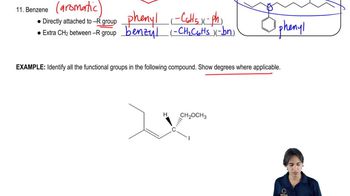
Identifying Functional Groups

Structural Representation

Structural representation refers to the way in which the arrangement of atoms in a molecule is depicted. This can include Lewis structures, condensed formulas, or skeletal structures. Accurately drawing these structures is essential for visualizing molecular geometry and understanding how different atoms are connected, which is vital for identifying compounds like tert-butylamine and n-octyl bromide.
Recommended video:
Guided course
05:09
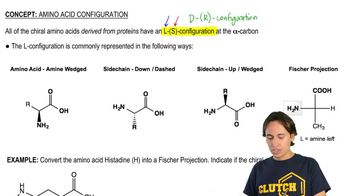
Representations of L-Configuration

Nomenclature

Nomenclature in organic chemistry is the system of naming chemical compounds based on their structure and functional groups. Understanding IUPAC naming conventions allows chemists to identify and communicate the identity of compounds clearly. For instance, 'tert-butylamine' indicates a specific branched amine, while 'n-octyl bromide' denotes a straight-chain alkyl halide, highlighting the importance of proper naming in organic chemistry.
Recommended video:
4:02
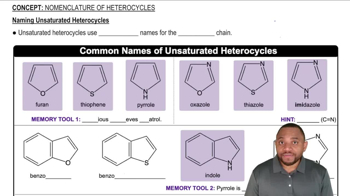
Nomenclature of Heterocycles Concept 2