Ch. 3 - An Introduction to Organic Compounds:Nomenclature, Physical Properties, and Structure
Bruice - Organic Chemistry 8th Edition
Bruice8th EditionOrganic ChemistryISBN: 9780135213711Not the one you use?Change textbook
Chapter 4, Problem 90

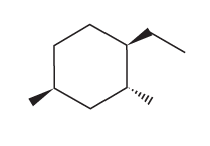
Draw the conformers for the following trisubstituted cyclohexane. Calculate the strain energy of each conformer. (The gauche interaction between a methyl and an ethyl group is 0.96 kcal/mol; the 1,3-diaxial interaction between a methyl and an H is 0.87 kcal/mol and between an ethyl and an H is 1.00 kcal/mol.)
Skeletal structure of a cyclohexane with a methyl and ethyl group, illustrating chair conformations for energy calculations.

Verified step by step guidance
1
Step 1: Begin by identifying the substituents on the cyclohexane ring. Label the positions of the substituents (e.g., methyl, ethyl, and any other groups) on the cyclohexane structure. Ensure you understand their relative positions (e.g., axial or equatorial).
Step 2: Draw the two possible chair conformations of the cyclohexane ring. In each conformation, place the substituents in either axial or equatorial positions based on their orientation. Remember that axial positions are perpendicular to the plane of the ring, while equatorial positions are roughly parallel to the plane.
Step 3: Evaluate the steric interactions in each conformer. Specifically, calculate the strain energy contributions from the 1,3-diaxial interactions for each substituent (e.g., methyl and ethyl groups) with axial hydrogens. Use the given values: 0.87 kcal/mol for methyl-H interactions and 1.00 kcal/mol for ethyl-H interactions.
Step 4: Consider any gauche interactions between substituents. For example, calculate the gauche interaction energy between the methyl and ethyl groups if they are in close proximity. Use the given value of 0.96 kcal/mol for this interaction.
Step 5: Sum the strain energy contributions for each conformer (1,3-diaxial interactions and gauche interactions) to determine the total strain energy for each conformer. Compare the strain energies to identify the more stable conformer.

Verified video answer for a similar problem:

This video solution was recommended by our tutors as helpful for the problem above.
Video duration:
11m
Was this helpful?

Key Concepts

Here are the essential concepts you must grasp in order to answer the question correctly.

Conformational Analysis

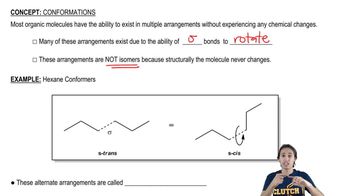
Conformational analysis involves studying the different spatial arrangements of a molecule that can be interconverted by rotation around single bonds. In cyclohexane, this includes chair and boat conformations, which can be further analyzed for steric interactions and strain. Understanding these conformers is essential for predicting the stability and reactivity of cyclic compounds.
Recommended video:
Guided course
03:29
Understanding what a conformer is.

Steric Strain

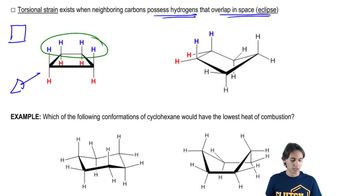
Steric strain arises when atoms are forced closer together than their preferred distance, leading to increased energy in a molecule. In cyclohexane derivatives, steric strain can occur due to interactions between substituents, such as 1,3-diaxial interactions and gauche interactions. Recognizing these interactions is crucial for calculating the overall strain energy of different conformers.
Recommended video:
Guided course
02:00
What is torsional strain?

Strain Energy Calculation

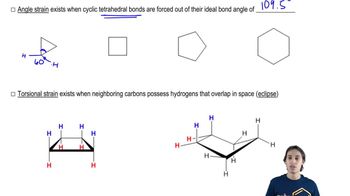
Strain energy calculation involves quantifying the energy associated with the strain in a molecule due to unfavorable interactions. For cyclohexane derivatives, this includes adding the contributions from various steric interactions, such as gauche and 1,3-diaxial interactions. This calculation helps in determining the most stable conformer by comparing the total strain energies of each possible arrangement.
Recommended video:
Guided course
02:46
What is angle strain?