Ch. 3 - An Introduction to Organic Compounds:Nomenclature, Physical Properties, and Structure
Bruice - Organic Chemistry 8th Edition
Bruice8th EditionOrganic ChemistryISBN: 9780135213711Not the one you use?Change textbook
Chapter 4, Problem 19a

Draw a condensed and a skeletal structure for each of the following:
a. 3,4-diethyl-2-methylheptane

Verified step by step guidance
1
Step 1: Understand the IUPAC name '3,4-diethyl-2-methylheptane'. The parent chain is 'heptane', which means it is a seven-carbon straight chain alkane. The substituents are located at carbons 2, 3, and 4, as indicated by the name.
Step 2: Identify the substituents. The '2-methyl' indicates a methyl group (-CH₃) attached to the second carbon of the heptane chain. The '3,4-diethyl' indicates two ethyl groups (-CH₂CH₃), one attached to the third carbon and the other to the fourth carbon.
Step 3: Draw the condensed structure. Start with the seven-carbon chain (heptane) and add the substituents at the appropriate positions. For example, at carbon 2, add a -CH₃ group, and at carbons 3 and 4, add -CH₂CH₃ groups.
Step 4: Draw the skeletal structure. Represent the seven-carbon chain as a zigzag line, with each vertex representing a carbon atom. Add the substituents as lines branching off the main chain at the appropriate positions. Use shorter lines for methyl groups and longer lines for ethyl groups.
Step 5: Double-check the structure to ensure all carbons have four bonds and the substituents are placed correctly according to the IUPAC name. Verify that the condensed and skeletal structures are consistent with each other.

Verified video answer for a similar problem:

This video solution was recommended by our tutors as helpful for the problem above.
Video duration:
7m
Was this helpful?

Key Concepts

Here are the essential concepts you must grasp in order to answer the question correctly.

Condensed Structural Formula

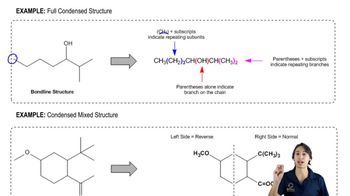
A condensed structural formula is a way of representing a chemical compound that shows the arrangement of atoms in a molecule without depicting all the bonds explicitly. In this format, groups of atoms are often grouped together, and hydrogen atoms attached to carbon are usually implied rather than shown. This method provides a clear and concise way to visualize the molecular structure while maintaining essential information about connectivity.
Recommended video:
Guided course
06:06
How to interpret condensed structures.

Skeletal Structure

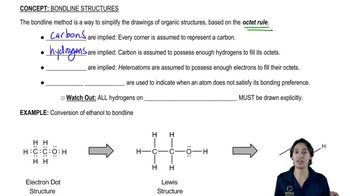
A skeletal structure, also known as a line-angle formula, is a simplified representation of a molecule where carbon atoms are represented by vertices or ends of lines, and hydrogen atoms are omitted for clarity. Each vertex represents a carbon atom, and the implicit hydrogen atoms are assumed to satisfy carbon's tetravalency. This format is particularly useful for visualizing larger organic molecules, as it reduces clutter and highlights the overall framework of the compound.
Recommended video:
Guided course
04:03
How bondline is different from Lewis Structures.

IUPAC Nomenclature

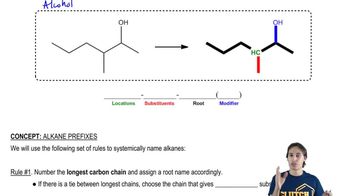
IUPAC nomenclature is a systematic method for naming organic chemical compounds based on their structure. It provides rules for identifying the longest carbon chain, substituents, and their positions, which is essential for accurately interpreting and drawing chemical structures. In the case of 3,4-diethyl-2-methylheptane, understanding the nomenclature helps in determining the correct arrangement of carbon chains and substituents in both condensed and skeletal forms.
Recommended video:
Guided course
03:43
The different parts of an IUPAC name